

About this fungus
Trooping Crumble Cap is a fungus in the Psathyrellaceae family. Its habitat and field characteristics are summarised below.
Hundreds of tiny, fragile grey-buff mushrooms can cover a stump, log or patch of ground above buried roots. The massed troop is often more striking than any single cap.
What to check
Check for very large numbers growing directly from dead wood or its buried roots. Individual caps are ovoid at first, then bell-shaped, finely pleated and usually less than 2cm wide. The ringless white stems are threadlike, the gills turn from white through grey to black, and mature caps wither rather than dissolving into ink.
Variation
Young caps may be cream, buff or pale tan with a darker centre. They become greyer as the spores mature and can darken almost to black before collapsing. A fruiting may appear rapidly and disappear within a few days.
Lookalikes
Coprinellus micaceus also grows from buried or exposed wood, but its caps and stems are larger and young caps often carry sparkling veil grains. Other members of Coprinellus section Disseminati can be nearly identical, especially outside Europe, and exact separation may require microscopy or DNA evidence.
Habitat and range
Saprotrophic on decaying stumps, logs and buried roots, especially broadleaf wood. It is reported widely, but recent work shows that some Asian and tropical records under this name belong to close species.
Food safety
Edible.
Use this profile to learn what to examine and compare, not as proof that a mushroom is safe to eat. Check the whole specimen and every important lookalike before reaching an identification.
Photographs
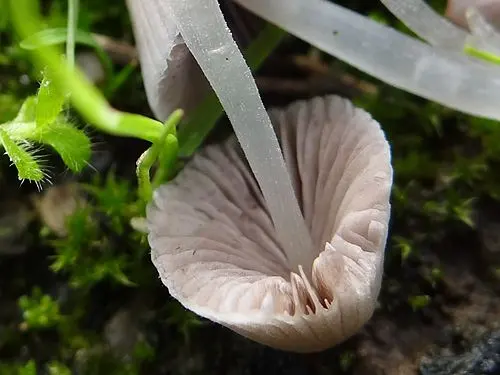 Jerzy Opioła / CC BY-SA 3.0
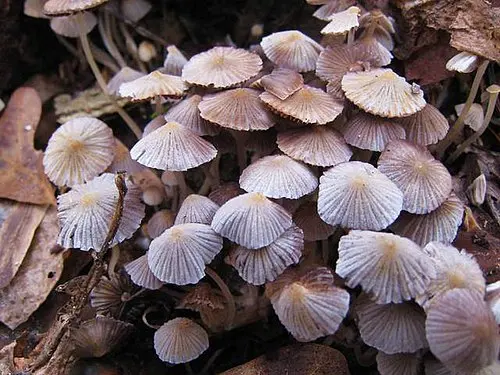 Amanita77 / CC BY-SA 3.0