

About this fungus
Trooping Funnel is a fungus in the Tricholomataceae family. Its habitat and field characteristics are summarised below.
A large, tall, pale buff funnel that often fruits in conspicuous troops, arcs or fairy rings in woodland and grassy edges.
What to check
Check the whole fruit body. Mature caps are broad funnels that usually retain a low central boss, the crowded pale gills run well down a long sturdy stem, and there is no ring or volva. Record size because several poisonous pale funnels are much smaller. A sweet or almond-like odour may be present but is variable and should not decide the identification.
Variation
Young caps are domed with an inrolled margin. They flatten and become broadly funnel-shaped, while colour ranges from cream and pale ochre to buff or flesh-tan depending on age and weather.
Lookalikes
Clitocybe rivulosa and related muscarine-containing funnels are smaller and more slender but can overlap in colour and habitat. The Common Funnel is also smaller and less robust. Leucopaxillus giganteus can be very large but normally lacks the persistent central boss. Do not identify a small pale funnel as this species from colour alone.
Habitat and range
Saprotrophic in leaf litter and soil in broadleaved or mixed woodland, rides, hedgebanks and grassy clearings. It often returns in extensive arcs or rings during autumn and early winter.
Food safety
Edible and good.
Use this profile to learn what to examine and compare, not as proof that a mushroom is safe to eat. Check the whole specimen and every important lookalike before reaching an identification.
Photographs
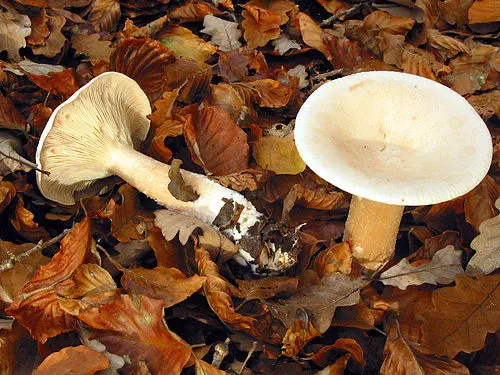 Jean-Pol GRANDMONT / CC BY 3.0
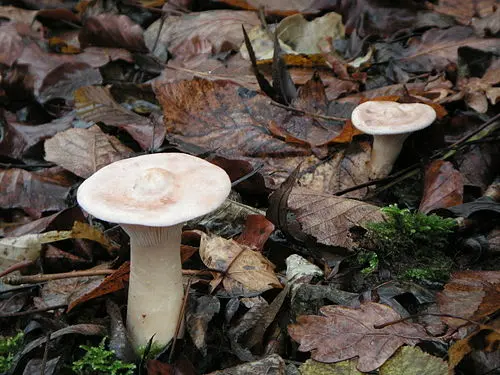 Charles Sommer / Public Domain