About this fungus
Trumpet Chanterelle is a fungus in the Cantharellaceae family. Its habitat and field characteristics are summarised below.
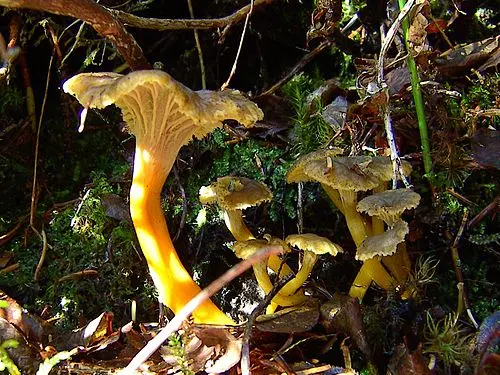
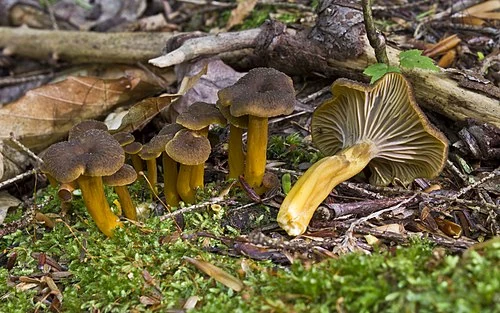
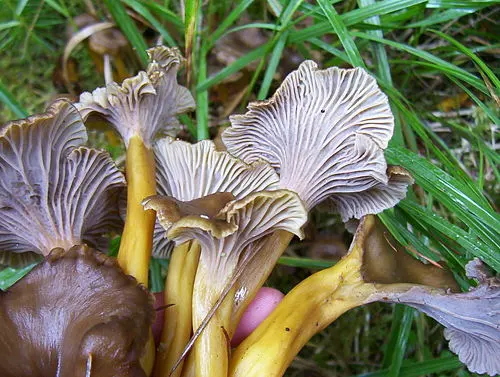
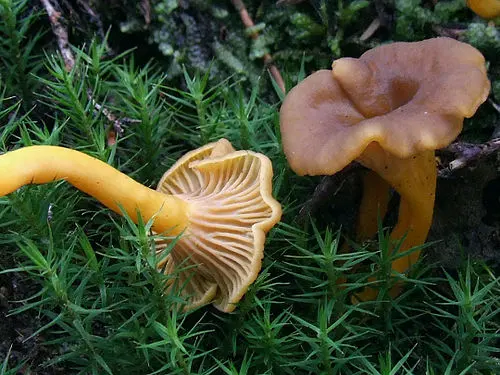
A small, slender chanterelle with a brown funnel-shaped cap, a hollow yellow to yellow-brown stem and pale forked ridges running down the underside.
What to check
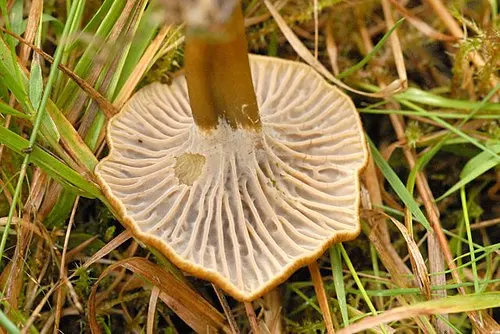
The underside has blunt, forking, cross-connected ridges rather than thin blade-like true gills. The stem is hollow, smooth and often flattened or grooved, with no ring or volva. Check these structural features before colour.
Variation
Caps range from yellow-brown to very dark grey-brown and often become more deeply funnelled with age. The false gills may be yellowish, grey, brownish or faintly lilac, while the stem dulls from orange-yellow towards brownish yellow.
Lookalikes
Craterellus lutescens usually has a smoother, less strongly ridged underside. False Chanterelle and small brown gilled mushrooms have thin true gills rather than blunt folds. Related yellowfoot species differ by region, so North American finds may need regional references.
Habitat and range
Mycorrhizal mainly with conifers in damp mossy woodland, bogs and montane forests. Fruitbodies may appear to grow from moss-covered rotten logs, but the fungus obtains nutrients through its tree association rather than by decaying the wood.
Food safety
Choice edible.
Use this profile to learn what to examine and compare, not as proof that a mushroom is safe to eat. Check the whole specimen and every important lookalike before reaching an identification.
Photographs
 CC BY-SA 3.0
 James Lindsey / CC BY-SA 3.0
 Ben Mitchell / Public Domain
 Jerzy Opioła / CC BY-SA 4.0