

About this fungus
Turkey Tail is a fungus in the Polyporaceae family. Its habitat and field characteristics are summarised below.
A thin, flexible bracket that forms overlapping shelves or rosettes on dead wood. Its upper surface is divided into sharply contrasting concentric bands and feels finely velvety. The colours vary enormously, but the fresh growing edge is often pale.
What to check
Turn a bracket over and look closely. Turkey Tail has a white to cream pore surface with about 3 to 8 very small round pores per millimetre, not gills and not a smooth surface. The cap is only a few millimetres thick, flexible when fresh and distinctly velvety above, with clear bands of colour. These characters together are more reliable than colour alone.
Variation
Bands can include cream, grey, brown, cinnamon, rust, reddish brown and almost black, with occasional blue or green tones. Algae may add green to older caps. Some collections are pale and others very dark. The underside remains pale, although it can become cream or slightly brownish with age.
Lookalikes
False Turkey Tail and other Stereum crusts can look convincingly banded from above but have a smooth underside without true pores. Hairy Bracket, Trametes hirsuta, is usually thicker, greyer and more coarsely hairy. Ochre Bracket, Trametes ochracea, is firmer and has less sharply contrasting zones. Other small Trametes can be difficult, so check pore size, cap texture and thickness rather than relying on the pattern alone.
Habitat and range
Saprotrophic and responsible for white rot, mainly on dead hardwood logs, stumps, fallen branches and standing dead trunks. It occasionally grows on conifer wood. Clusters persist for much of the year and the species is widespread across temperate and subtropical regions worldwide.
Food safety
Inedible.
Photographs
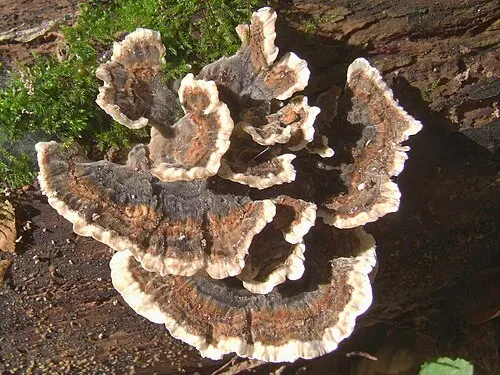 Jerzy Opioła / CC BY-SA 4.0
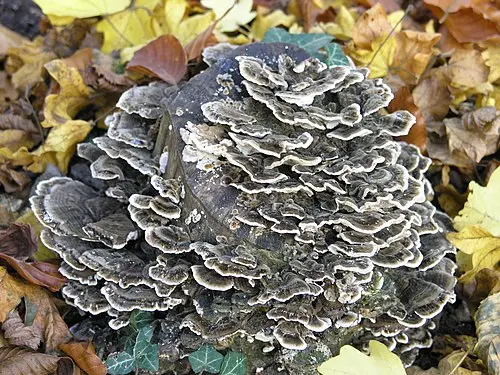 Lukas Riebling / CC BY-SA 3.0
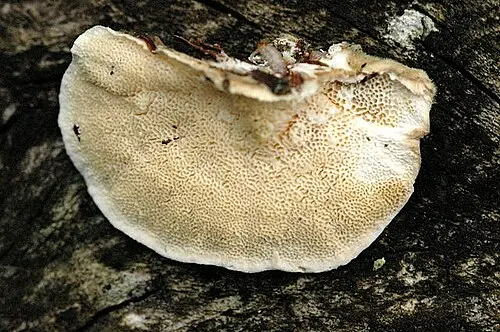 James Lindsey / CC BY-SA 3.0