
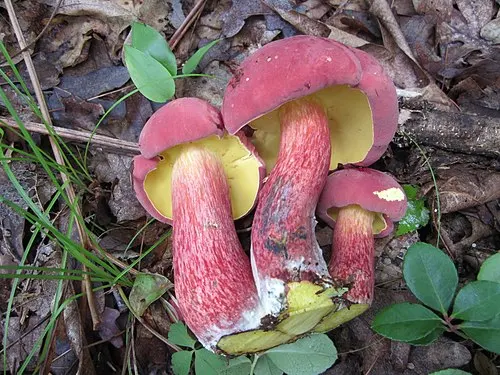
About this fungus
Two-colored Bolete is a fungus in the Boletaceae family. Its habitat and field characteristics are summarised below.
A medium to large eastern North American bolete with a rose-red to brick-red cap, bright yellow pores and a stem that is red for most of its length but yellow at the top.
What to check
Use the whole combination: a dry red cap, shallow yellow tubes, pores that usually bruise blue, a solid stem red nearly to the apex and yellow flesh that changes little or only faintly and unevenly when cut. There is no ring or volva. Record separate reactions on the pores, cap flesh and stem flesh because they can differ.
Variation
Young caps may be pink-red and can rarely begin almost yellow, while older caps fade or crack. Pores become orange-yellow to dull olive-yellow. The pore surface often blues promptly but can react slowly, while the stem and cut flesh usually show little or irregular blue staining. Odour and fine stem netting are also variable.
Lookalikes
Boletus sensibilis and Lanmaoa pseudosensibilis overlap strongly in colour and can be confused with this species. Boletus sensibilis usually has deeper tubes and much stronger blue staining through the cut flesh, but reaction speed alone is not a safe decision rule. Numerous smaller red-capped boletes also occur. Compare size, tube depth, stem colour, cut-flesh reaction and microscopic features where needed.
Habitat and range
Mycorrhizal with oaks on woodland soil, fruiting in summer and autumn across eastern North America east of the Rocky Mountains. Similar red-and-yellow boletes elsewhere should not automatically be assigned this North American name.
Food safety
Edible.
Use this profile to learn what to examine and compare, not as proof that a mushroom is safe to eat. Check the whole specimen and every important lookalike before reaching an identification.
Photographs
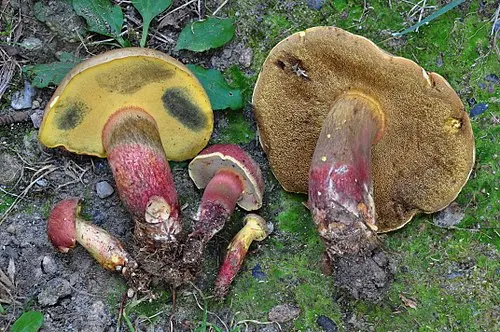 Joshua Hutchins / CC BY-SA 3.0