

About this fungus
Twotone Funnel is a fungus in the Clitocybaceae family. Its habitat and field characteristics are summarised below.
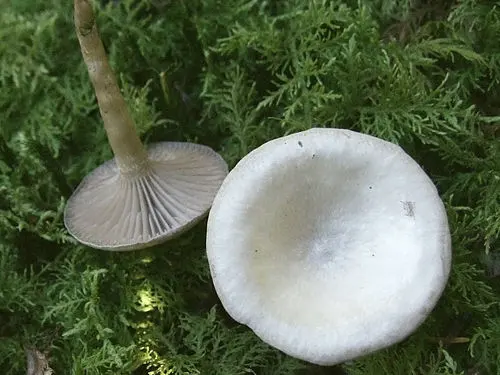
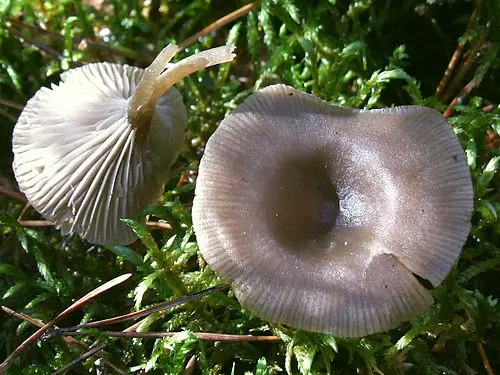
A small, thin woodland funnel whose colour can change dramatically as it dries. Moist caps are grey-buff to grey-brown, usually darkest in the shallow central hollow, and their margins may show fine translucent lines. Dry caps fade towards dirty white or very pale grey while the centre often remains darker, creating the two-tone effect behind the common name.
What to check
Look for a cap only about 1 to 5 cm across, low-convex at first and then flat with a depressed or navel-like centre rather than a consistently deep funnel. The cream to pale grey-brown gills run a short distance down the stem and range from moderately spaced to crowded. The slender grey-white to pale buff stem is finely fibrous, becomes darker towards the base and may become hollow. The spore print is white, the smell is usually faint and there is no ring or volva. Because close species overlap, spore size and cap-surface microscopy may be needed.
Variation
A damp mushroom can look grey-brown and strongly striate, then fade to pale grey or almost white as moisture leaves the cap. Young caps are low-convex; older ones become flat, depressed or umbilicate but are not always deeply funnelled. A yellow-brown form has been described, and regional lookalikes can produce similar cream, tan and grey combinations. Photographs taken at different moisture stages can therefore appear to show different species.
Lookalikes
Clitocybe vibecina is similar but is usually associated with a conspicuous rancid or mealy smell. Clitocybe amarescens and other grey-brown funnels overlap in woodland litter. In North America, C. pseudodicolor is separated partly by cap development and microscopic spore size. Pale forms can also resemble the toxic Fool's Funnel group, although those are more typical of grass and often have a frosted white cap. No ring or volva does not make a small funnel safe, because many toxic Clitocybe species also lack both.
Habitat and range
Saprotrophic on leaf and needle litter in coniferous and deciduous woodland and sometimes on heathland or grass. It usually fruits in scattered groups or troops from late summer into late autumn, with later records in milder regions. The European concept is well established, but records under this name in North America and New Zealand need a current regional key because similar species and unresolved local collections exist.
Food safety
Inedible.
Photographs
 Jerzy Opioła / CC BY-SA 3.0
 Jerzy Opioła / CC BY-SA 3.0