
About this fungus
Ugly Milkcap is a fungus in the Russulaceae family. Its habitat and field characteristics are summarised below.
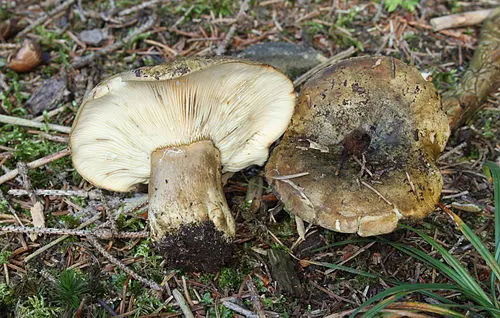
A large, heavy milkcap with a slimy olive-brown to almost black cap, a deeply depressed centre and a thick margin that stays inrolled for a long time. Dirt often sticks to the cap, reinforcing its untidy appearance.
What to check
Look for a 7 to 20 cm sticky dark cap, crowded cream gills running down a stout stem, and abundant white latex from damaged gills. The latex and damaged tissues slowly develop dull olive to brown staining. The stem may be shallowly pitted. The spore print is pale cream, and there is no ring or volva.
Variation
Caps range from olive-brown and umber to nearly black, often paler at the inrolled margin. Dry specimens lose much of their slime, while handling and age darken the gills and flesh. Buried litter can make the surface look unusually rough or patched.
Lookalikes
Beech Milkcap, Lactarius blennius, is smaller and paler and is associated mainly with beech. Other dark acrid milkcaps can overlap in cap colour and latex staining, so host, microscopic characters and the whole fruit body matter. A dark cap alone is not sufficient.
Habitat and range
Ectomycorrhizal and especially associated with birch in damp woodland. It is also reported with spruce, pine and other trees in mixed and boreal forests across Eurasia.
Food safety
Inedible.
Photographs
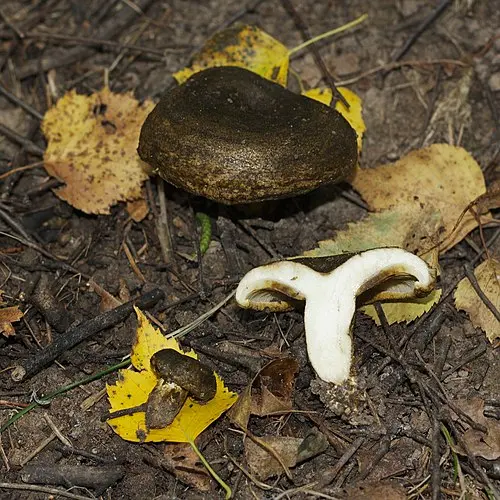 Tauno Erik / CC BY-SA 3.0
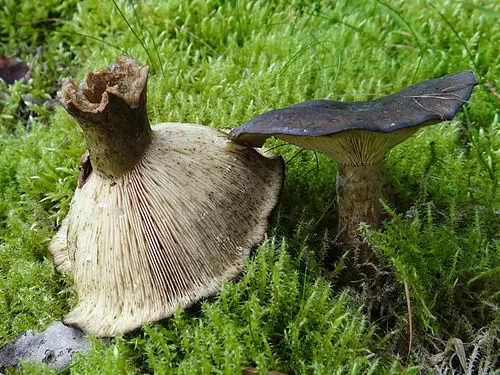 Jerzy Opioła / CC BY-SA 3.0