
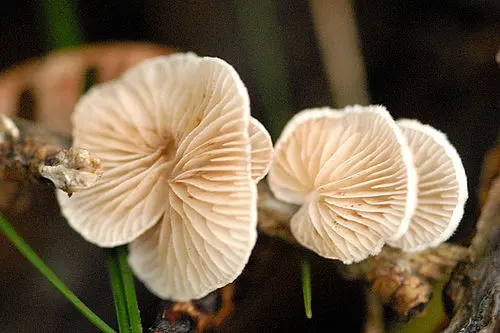
About this fungus
Variable Oysterling is a fungus in the Crepidotaceae family. Its habitat and field characteristics are summarised below.
A tiny white oysterling attached directly to a fallen twig, with no obvious stem. Its cap may be kidney-shaped, fan-shaped or almost round depending on where it grows. The upper surface is dry and finely felted, while pale gills spread out from the point where the cap meets the wood.
What to check
Look for a cap only 0. 5 to 2 cm across, usually white and softly hairy, with no more than a tiny side attachment in place of a stem. The gills begin whitish and mature through ochraceous or pinkish cinnamon to cinnamon-brown. The spore print is pinkish cinnamon to brown, not pinkish white. These features establish a Crepidotus, but they do not reliably settle the exact species. Variable Oysterling has elongated, finely warted spores and characteristic cells along the gill edge, so a confident species record normally needs microscopy.
Variation
Position on the substrate changes the shape. Caps growing from the side of a twig are often semicircular or kidney-shaped, while those beneath it can become almost round. The margin may be lobed or wavy. Caps usually remain white or become slightly cream with age, while the most noticeable colour change occurs in the gills as the brownish spores mature.
Lookalikes
Roundspored Oysterling, Crepidotus cesatii, is extremely similar in the field and is separated mainly by its broader, more rounded spores. Modern research has also found several close relatives within the Crepidotus variabilis lineage that require spore and gill-edge cell measurements. Peeling Oysterling, Crepidotus mollis, is usually larger and has a gelatinous cap skin that can stretch when pulled.
Habitat and range
Saprotrophic on dead plant material, especially fallen hardwood twigs and small branches, but also recorded on woody litter and herbaceous stems. It occurs in deciduous and mixed woodland, scrub and hedgerows, singly or in overlapping groups. European records run from lowlands into mountain woodland and mainly from late summer into winter. Similar pale Crepidotus occur more widely, so records outside Europe need the same microscopic care rather than assuming that appearance proves the European species.
Food safety
Poisonous.
Photographs
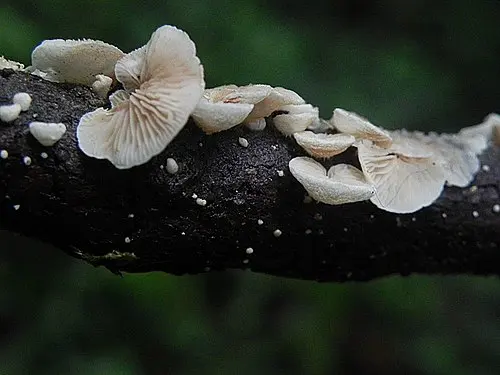 Teuch67 / CC BY-SA 4.0
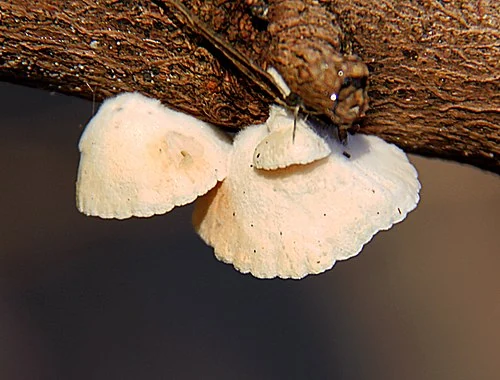 Dwergenpaartje / CC BY-SA 4.0
 Dwergenpaartje / CC BY-SA 4.0