

About this fungus
Veiled Poisonpie is a fungus in the Hymenogastraceae family. Its habitat and field characteristics are summarised below.
A small to medium Hebeloma whose cap is usually distinctly two-coloured. The centre is date-brown, cinnamon, olive-brown or brick-brown, then fades through buff to a much paler cream edge. Damp caps are smooth, shiny and tacky. Young mushrooms carry fine pale veil material around the cap edge and on the stem, giving this species its English name.
What to check
Look for the combined pattern of a sticky two-coloured cap, pale veil remnants on young specimens, attached or notched gills and a dark olive-brown to umber spore print. The partial veil can leave fine fibres along the cap edge and a broken ring-like zone on the stem, but it does not form a durable membranous ring. Gills begin pale brown and mature to ochre-brown or dark brown, normally keeping a paler fringed edge. The stem often browns from the base upwards. A radish-like smell is common when the flesh is cut, although it can occasionally be absent.
Variation
The cap can be only 1 cm wide in harsh Arctic or alpine sites and reach about 6. 5 cm in more favourable conditions. Its centre ranges from pinkish buff through cinnamon and olive-brown to sepia or dark brick, while the edge may be cream, grey-buff, pink-buff or light brown. Some specimens are far less obviously two-coloured. The young edge may be rolled inward, while old caps can split radially, become ragged or turn upwards. Veil fibres wear away with age, and the stem gradually changes from whitish to grey-brown or dark brown at the base.
Lookalikes
Many veiled Hebeloma species share brown spores, a radish-like smell and fibrous veil remnants. Hebeloma marginatulum is an important comparison in Arctic and alpine habitats, where Veiled Poisonpie can also develop unusually large spores. Its strongly two-coloured cap often helps, but secure separation may still need measurements of spores and gill-edge cells. Hebeloma incarnatulum is a similar North American species that has probably been overlooked, while Hebeloma excedens and Hebeloma pubescens can overlap in the usual DNA barcode. A field photograph can support this identification, but microscopy and sometimes several DNA regions are needed when the collection is atypical.
Habitat and range
Ectomycorrhizal with a wide range of trees and shrubs rather than only conifers. Pine and birch are frequent partners in European woodland, while verified records also occur with willow, mountain avens and other broadleaf or conifer hosts. Habitats include woodland, parks, pathsides, gardens, heath, dunes, scrub and Arctic or alpine ground. Modern evidence confirms a broad Northern Hemisphere range from Mediterranean and temperate regions through boreal woodland to Greenland and the Rocky Mountains, although it becomes less common in the coldest areas.
Food safety
Inedible.
Photographs
 Cripps et al. / CC BY 4.0, cropped from Figure 17
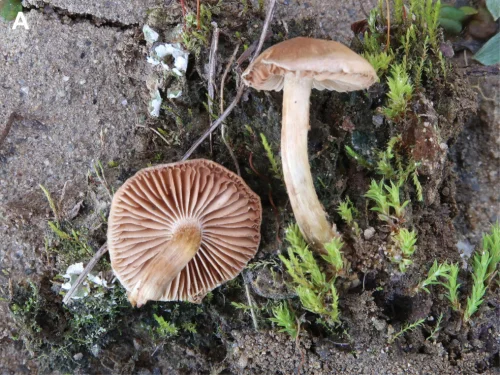 Henning Knudsen and Eberhardt et al. / CC BY 4.0, cropped from Figure 16