

About this fungus
Velvet Bolete is a fungus in the Suillaceae family. Its habitat and field characteristics are summarised below.
A dry, finely velvety yellow-brown bolete of pine woods, with mustard-yellow pores and no ring.
What to check
Look for a matt cap covered in tiny darker scales, small mustard to olive-brown pores, a ringless yellow-brown stem and flesh that may stain blue above the tubes after damage. The cap can become slightly tacky in rain but is not heavily slimy.
Variation
Caps range from yellow-ochre to rusty tawny or olive-brown. The pore surface darkens toward cinnamon-brown with age, and the blue reaction can be weak or patchy.
Lookalikes
Suillus grevillei has a distinct ring and is associated with larch. In North America, S. tomentosus is a close pine-associated counterpart, so records of European S. variegatus require regional care.
Habitat and range
Mycorrhizal with two-needle pines on acidic, often sandy soil in woodland and heath. It is principally Eurasian; similar North American fungi may be S. tomentosus.
Food safety
Edible.
Use this profile to learn what to examine and compare, not as proof that a mushroom is safe to eat. Check the whole specimen and every important lookalike before reaching an identification.
Photographs
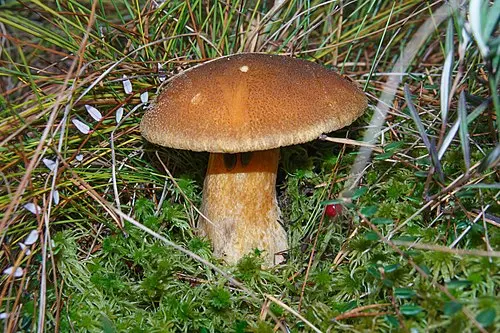 Andrey Gaverdovsky / CC BY 2.0
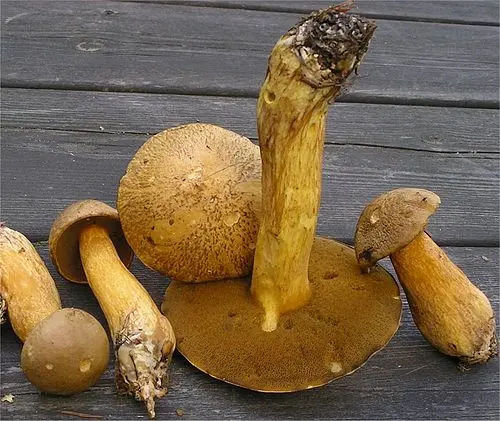 Irene Andersson (irenea) / CC BY-SA 3.0