

About this fungus
Verdigris Agaric is a fungus in the Hymenogastraceae family. Its habitat and field characteristics are summarised below.
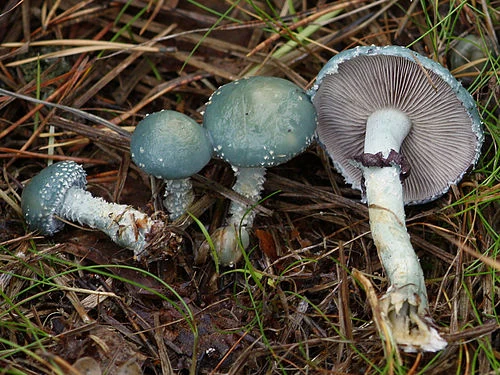
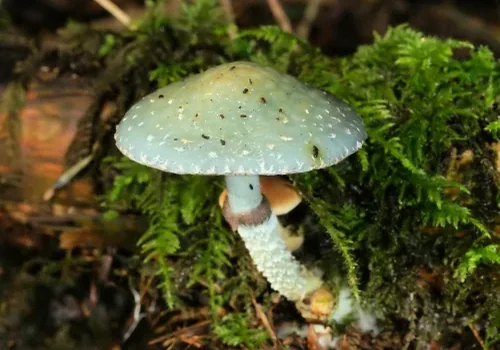
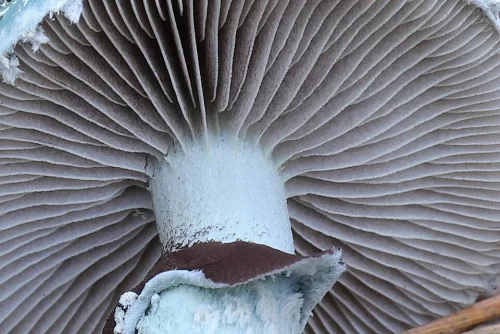
A memorable blue-green woodland mushroom with a cap that looks varnished or almost glassy when wet. Fresh young caps are usually dotted with white veil fragments. The pale stem is shaggy or scaly below a ring, while the gills darken from pale grey to purple-grey as the mushroom matures.
What to check
Look for the combined pattern of a very slimy blue-green cap, scattered white veil flecks, broadly attached gills and a ring on the upper stem. The ring is often flared and ragged when young, then may collapse into a dark purple-brown spore-stained band. The stem is usually white and noticeably scaly below it. Mature gills have purple-grey faces with contrasting pale edges, and the spore print is purplish black. There is no volva at the base.
Variation
Colour changes dramatically with age and weather. Deep blue-green or turquoise young caps fade through yellow-green to pale yellowish brown, often from the centre outwards. Rain can wash away the white veil flecks, and the ring may become ragged or shrink to a stained zone. This means an old pale specimen can look quite different from the fresh mushrooms shown in many guides. Cap colour alone is not enough for identification.
Lookalikes
The blue-green Stropharia group is difficult. Stropharia caerulea usually has a weaker or incomplete ring, a smoother stem and a cap that fades more completely, but intermediate collections are common and visible characters may not settle the name. Stropharia pseudocyanea is often smaller and paler, commonly appears in grass and also has a poorly developed ring. Microscopy may be needed for both. Aniseed Funnel, Clitocybe odora, can be similarly blue-green but has a dry cap, no ring, pale spores and a strong aniseed smell.
Habitat and range
Saprobic, feeding on dead plant material rather than partnering with a living tree. It grows on rich soil, leaf litter and woody debris beneath broadleaf or conifer trees, and also occurs along paths, in parks, grass, mulch and other disturbed ground. It may appear alone or in small groups. The species is well documented across Europe and in northern, montane and western parts of North America, but close blue-green relatives must be considered wherever it is found.
Food safety
Inedible.
Photographs
 Anneli Salo / CC BY-SA 3.0
 Hans Hillewaert / CC BY-SA 4.0
 Colussi.g / CC BY 4.0
Species to compare
Similar mushrooms to compare against: