
About this fungus
Viscid Violet Cort is a fungus in the Cortinariaceae family. Its habitat and field characteristics are summarised below.
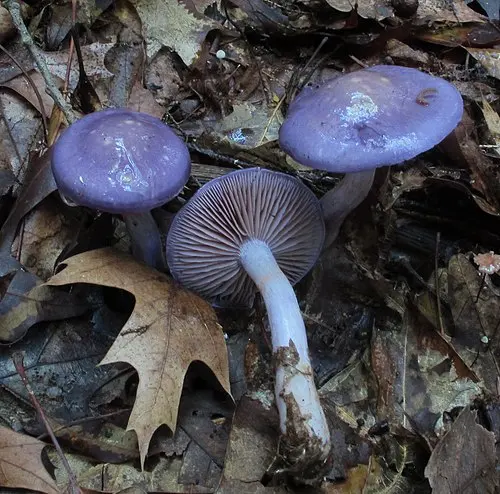
A small eastern North American woodland Cortinarius with a glossy, slimy violet to lilac cap and stem. The cap develops irregular yellowish or tan spots as it matures and can eventually fade almost completely to greyish tan.
What to check
Check that both cap and stem are glutinous when fresh. The attached gills begin pale violet or lilac and become cinnamon to rusty brown as the spores mature. Young fruit bodies have a cobweb-like cortina over the gills, later leaving rusty fibres or a faint ring zone on the upper stem rather than a true ring. The spore print is rusty brown and there is no volva.
Variation
Fresh young caps can be deep violet, lavender or lilac. Yellowish-brown spots spread from the centre with age, sometimes leaving a mottled greenish, tan or grey-brown cap. Drying can make the normally slimy surfaces appear less glossy.
Lookalikes
Cortinarius iodeoides can look identical in the field and is best separated by its different spore size. Other violet Cortinarius overlap in colour and veil structure. Identification should therefore use the glutinous cap and stem, colour changes, host, spore print and, where needed, microscopy rather than cap colour alone.
Habitat and range
Ectomycorrhizal with hardwoods, especially oak, growing alone or in groups on woodland soil. Documented principally from eastern North America, with additional records from northern Asia, fruiting in summer and autumn and into winter along the Gulf Coast.
Food safety
Inedible.
Photographs
 Eric Smith / CC BY-SA 3.0