

About this fungus
Weeping Widow is a fungus in the Psathyrellaceae family. Its habitat and field characteristics are summarised below.
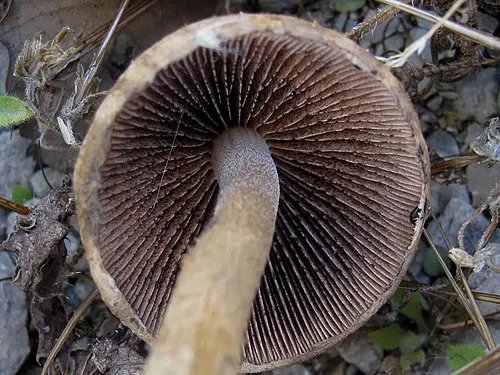
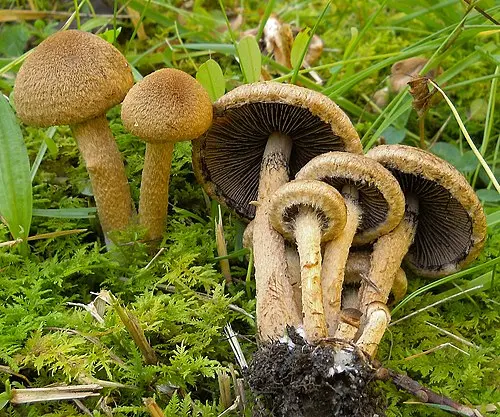
A woolly ochre-brown mushroom with a fringed cap edge, mottled dark gills and tiny dark droplets on the gill edges when fresh and damp.
What to check
Look for a fibrous cap, pale veil fragments around the margin, grey-brown gills that become mottled and nearly black, and a fragile fibrous ring zone stained by black spores. Fresh gills may carry dark liquid beads. There is no volva.
Variation
Young caps are shaggy and ochre to tan. Older caps become smoother and the gills darken from grey-brown to purplish-brown or black as the spores mature.
Lookalikes
Some Psathyrella and Panaeolus species also have dark spores, but usually lack the same combination of a stout woolly cap, fringed veil and weeping gill edges. Agaricus has free gills and a more persistent ring.
Habitat and range
Saprotrophic on rich soil, buried organic debris and disturbed ground in grassland, parks, roadside verges, gardens and woodland edges. It is widespread in temperate regions.
Food safety
Edibility is uncertain or disputed.
Photographs
 zaca / CC BY-SA 3.0
 Hamilton (ham) / CC BY-SA 3.0