

About this fungus
Western Jack-o'-lantern is a fungus in the Omphalotaceae family. Its habitat and field characteristics are summarised below.
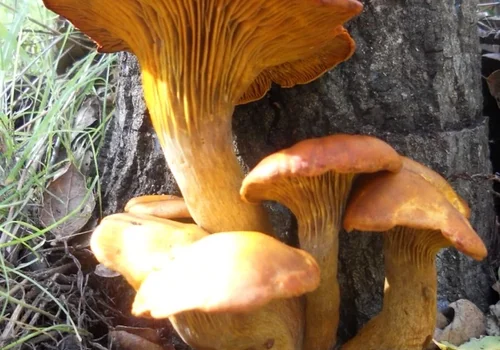
A large western North American wood-rotting mushroom that forms tight, overlapping clusters at the base of hardwoods or from buried roots. Fresh caps are dull orange to orange-brown, then often develop olive or darker brown tones. Mature caps flatten or become broadly funnel shaped with wavy edges.
What to check
The underside has thin, sharp-edged true gills that run a long way down the stem. They begin yellowish olive and become yellow to orange. The solid stem often narrows towards the base and has no ring. Fresh gills can give a faint greenish glow in full darkness, but the effect is variable and too difficult to see to serve as a dependable identification test. The spore print is white to very pale yellow.
Lookalikes
Western chanterelles also have yellow or orange funnel-shaped caps, but their undersides carry blunt, wrinkled ridges rather than separate blade-like gills. Chanterelles grow from soil in partnership with trees, while Western Jack-o'-lantern grows from wood, including buried roots that can make it appear soil-borne. Closely related jack-o'-lantern species elsewhere in North America, Europe, Asia and Australia share the clustered wood-growing habit and are also poisonous.
Habitat and range
Saprobic on hardwood, especially oak and eucalyptus, fruiting from stumps, trunks and buried roots. It is recorded mainly from California and Baja California, where it is most frequent from late autumn through winter after seasonal rain. Fruiting bodies are usually grouped into conspicuous clusters.
Food safety
Poisonous.
Photographs
 Jonny and Simone / CC BY-SA 3.0