
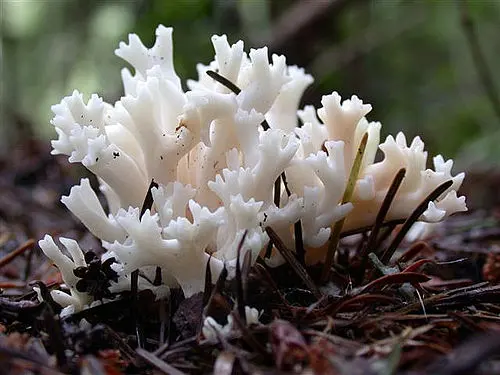
About this fungus
White Coral Fungus is a fungus in the Clavulinaceae family. Its habitat and field characteristics are summarised below.
A white to cream coral fungus with many upright branches ending in flattened, finely crested or comb-like tips.
What to check
Look closely at the branch ends for fringed or crested tips rather than simple rounded points. The fungus has no cap, gills, pores, ring or volva. White colour alone is not diagnostic, and microscopy may be needed for difficult coral fungi.
Variation
Branch tips brown with age. A parasitic fungus can turn whole fruit bodies grey or black and distort the branches, making them resemble other Clavulina species.
Lookalikes
Clavulina rugosa is less repeatedly branched, with wrinkled clubs and rounded tips. Clavulina cinerea is naturally grey. Ramariopsis kunzei has mostly blunt rather than clearly crested tips and differs microscopically.
Habitat and range
Usually regarded as mycorrhizal, growing on soil with broadleaf or conifer trees, often beside paths. It also occurs in some temperate grassland and dune habitats.
Food safety
Edible.
Use this profile to learn what to examine and compare, not as proof that a mushroom is safe to eat. Check the whole specimen and every important lookalike before reaching an identification.
Photographs
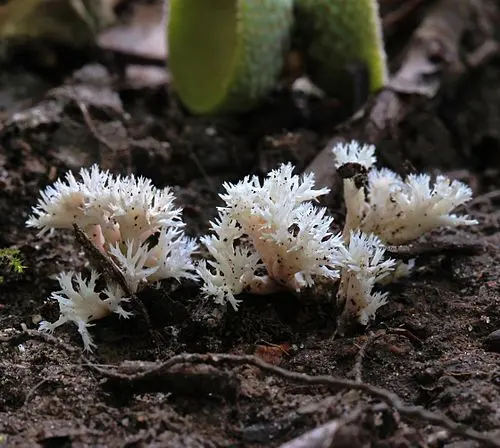 Stu's Images / CC BY-SA 4.0
Species to compare
Similar mushrooms to compare against: