

About this fungus
White Fibrecap is a fungus in the Inocybaceae family. Its habitat and field characteristics are summarised below.
A small, slender fibrecap with a satin-white to ivory cap and a distinct pointed centre. Young caps are conical, then broaden towards bell-shaped or convex while usually keeping the central umbo. Fine radial fibres give the dry cap a silky sheen. The gills begin pale but become grey-buff and finally clay-brown as spores mature, while the narrow pale stem remains ringless.
What to check
Check the combination of small size, dry silky cap, pointed umbo and brown-maturing gills. The cap is usually 1 to 4 cm across and can split radially at the edge with age. Gills are close, attached to the stem or slightly notched, and their edges may remain paler than their faces. A very short-lived cobwebby veil can cover young gills, but it does not leave a persistent ring. The spore print is dull clay-brown or snuff-brown. Smooth elliptical spores and abundant thick-walled, crystal-tipped cystidia are important microscopic checks. There is no volva.
Variation
White caps can develop cream, straw or ochre tones around the centre as they age, and the gills change much more noticeably from pale cream-grey to brown. The lilac mushrooms formerly called Inocybe geophylla var. lilacina should not simply be treated as a colour form: modern work recognises Inocybe lilacina and several related regional species. The white form itself also belongs to a difficult group, so faded or slightly violet material may require microscopy and DNA.
Lookalikes
Other pale Inocybe species can be extremely similar and often need spores, cystidia and DNA for separation. Inocybe lilacina and its relatives have lilac pigment but may fade. Small field mushrooms in Agaricus generally develop free pink to chocolate-brown gills and usually have a ring rather than a silky pointed cap. Pale bonnets and waxcaps tend to retain a white spore print.
Habitat and range
Ectomycorrhizal with both broadleaf trees and conifers, fruiting on soil in deciduous, mixed and coniferous woodland. It is particularly noticeable where litter is thin, including path edges, mossy banks, roadside verges and tree-planted parkland. Fruiting is mainly from summer into late autumn in temperate regions and can continue into winter in mild climates. Reports extend across Europe and North America, but members of the wider geophylla group should be interpreted with current regional keys.
Food safety
Poisonous.
Photographs
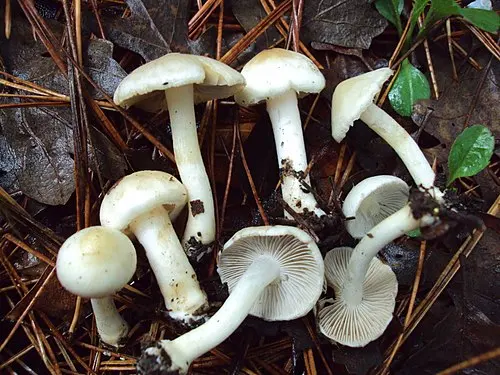 Richard Sullivan / CC BY-SA 3.0
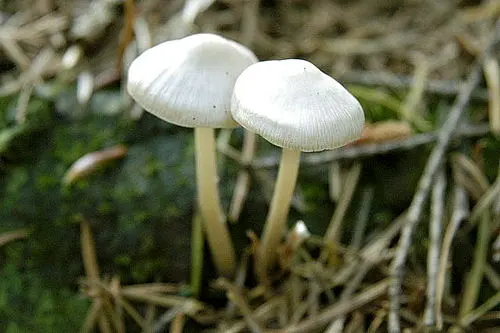 James Lindsey / CC BY-SA 3.0