

About this fungus
White-laced Shank is a fungus in the Marasmiaceae family. Its habitat and field characteristics are summarised below.
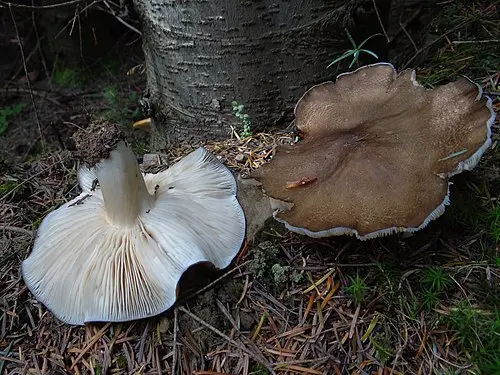
A fairly large grey-brown woodland mushroom with a radially streaked cap, very broad white gills and a slender pale stem. It grows from decaying wood or woody soil rather than ordinary bare soil.
What to check
Trace the stem base carefully and look for long white cord-like rhizomorphs running into rotten or buried wood. The broad gills are sinuate to narrowly attached and become cream with age. There is no ring or volva.
Variation
Caps range from dark grey-brown to pale ochre-grey and may split radially in dry weather. The white rhizomorphs can remain hidden in the substrate, so their absence from a quick surface view proves little.
Lookalikes
Melanoleuca species usually grow from soil and lack the same long white wood-bound rhizomorphs. North American mushrooms once called Megacollybia platyphylla belong to other species in the genus, so regional treatments matter and microscopy may be needed.
Habitat and range
Saprotrophic on and around well-decayed broadleaved trunks, branches, roots and buried woody debris, with conifer wood reported less often. The strict species is Eurasian; similar North American Megacollybia are now treated separately.
Food safety
Inedible.
Photographs
 Jerzy Opioła / CC BY-SA 4.0