

About this fungus
White Saddle is a fungus in the Helvellaceae family. Its habitat and field characteristics are summarised below.
A pale, brittle-looking saddle fungus with a curled and contorted cap raised on a striking white stem. Deep ribs and pocket-like channels run along the stem, giving the whole fruit body an architectural appearance unlike an ordinary cap-and-stem mushroom.
What to check
Look for two or three main cap lobes with many smaller folds and curls. The smooth upper surface is cream, ivory or pale ochre, while the underside is paler and finely downy. The cap edge is free from the stem. The white stem is deeply fluted, chambered and hollow, with no ring or volva. The spore print is white.
Variation
Some caps form a simple two-lobed saddle while others become a mass of irregular curls. Colour ranges from ivory and cream to pale ochre or occasionally pinkish buff. The thin flesh and hollow ribbed stem remain useful when the cap shape is unusually contorted.
Lookalikes
Helvella elastica has a smoother, slender stem without the same deep ribs and chambers. Helvella lacunosa usually has a grey-brown to black cap, although unusually pale forms can be confusing. Other pale Helvella may require microscopic and regional taxonomic checks, so cap colour alone is not decisive.
Habitat and range
Fruits on soil in broad-leaved and mixed woodland, especially with beech and oak, and often appears beside paths or in grassy woodland margins. It is recorded across Europe and parts of Asia and North America, mainly from summer through late autumn.
Food safety
Poisonous.
Photographs
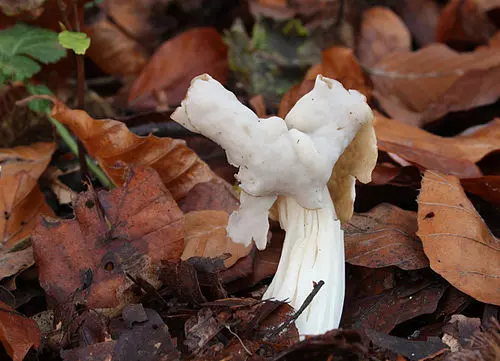 Holger Krisp / CC BY 3.0
Species to compare
Similar mushrooms to compare against: