

About this fungus
Witch's Hat is a fungus in the Hygrophoraceae family. Its habitat and field characteristics are summarised below.
A small, glossy waxcap with a pointed yellow, orange or red cap that progressively turns black. Fresh and old fruit bodies can look so different that the blackening reaction and conical shape are more informative than any one starting colour.
What to check
Look for a conical or bell-shaped cap that remains pointed as it expands, narrow pale yellow gills that become orange, and a slender yellow to orange stem. Handling, bruising and age produce grey-black to jet-black staining across the cap, gills and stem. The spore print is white, and there is no ring or volva. These characters identify the H. conica group more confidently than every regional member of the complex.
Variation
Young caps range from lemon-yellow through orange to scarlet-red. Some blacken quickly after damage, while others darken gradually with age, and old fruit bodies can remain standing as shiny black shells. Cap shape varies from sharply pointed to broadly conical but usually retains a central point.
Lookalikes
Dune Waxcap, Hygrocybe conicoides, is usually linked to dune grassland and often blackens more slowly, but speed alone is unreliable. Persistent Waxcap, Hygrocybe acutoconica, remains yellow to orange and does not blacken throughout. Other blackening waxcaps, including regional lineages around H. singeri, can require microscopy, ecology and DNA.
Habitat and range
In Europe it is characteristic of short, nutrient-poor waxcap grassland, including old lawns, pastures, churchyards and verges. Related members of the complex occur in woodland and other habitats elsewhere. Waxcap ecology is still being investigated and should not be labelled simply mycorrhizal or saprobic.
Food safety
Inedible.
Photographs
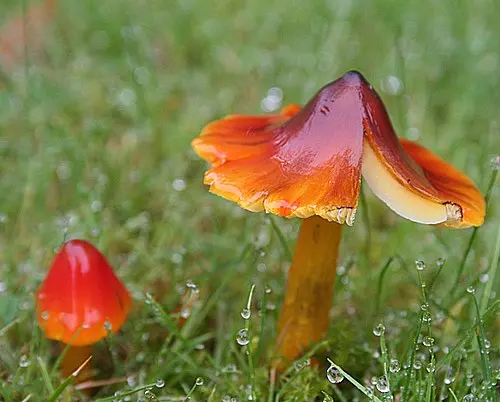 Anne Burgess / CC BY-SA 2.0
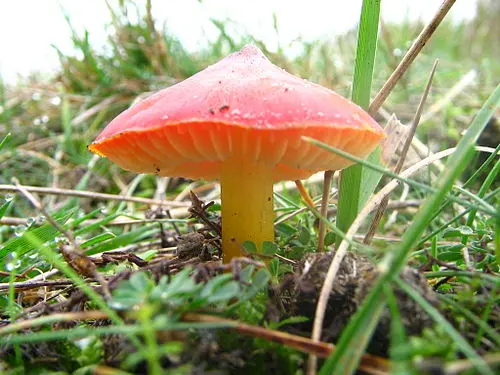 Taka / CC BY 2.5
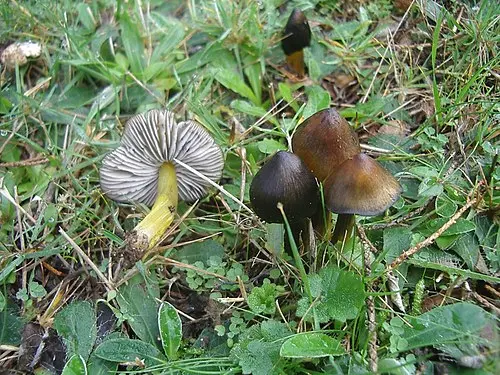 Jymm / Public Domain
Species to compare
Similar mushrooms to compare against: