

About this fungus
Wood Blewit is a fungus in the Tricholomataceae family. Its habitat and field characteristics are summarised below.
A substantial autumn mushroom with lilac to violet tones across the young cap, gills and stem. The cap soon fades towards grey, buff or brown, while the crowded gills often retain lilac for longer.
What to check
Use a complete combination: sinuate to broadly attached lilac gills, a pale pinkish-buff spore print, a sturdy ringless stem and no rusty veil deposits. The often sweet, perfumed or fruit-like odour is supportive but not unique. A pale print helps reject purple Cortinarius, but it does not rule out every pink-spored lookalike.
Variation
Colour is strongest in fresh young fruit bodies and fades markedly with age, weather and waterlogging. Mature caps may be almost entirely tan-brown, and old gills can lose most of their violet. This colour loss makes mixed-age groups more informative than a single specimen.
Lookalikes
Purple Cortinarius species develop rusty-brown spores and often leave a cobweb-like veil or rusty bands on the stem. Some are poisonous, including species associated with delayed kidney injury. Livid Pinkgill, Entoloma sinuatum, also has a pinkish spore print but usually lacks violet tones, has different gill development and is poisonous. Sordid Blewit, Lepista sordida, is usually smaller and thinner but can be difficult to separate.
Habitat and range
Saprotrophic in rich leaf litter, compost, wood-chip beds, hedgerows, gardens and broad-leaved or mixed woodland. It often fruits in troops, arcs or rings from autumn into winter. Sources now variously use Lepista nuda, Clitocybe nuda or Collybia nuda, and North American material may include close regional lineages.
Food safety
Choice edible.
Use this profile to learn what to examine and compare, not as proof that a mushroom is safe to eat. Check the whole specimen and every important lookalike before reaching an identification.
Photographs
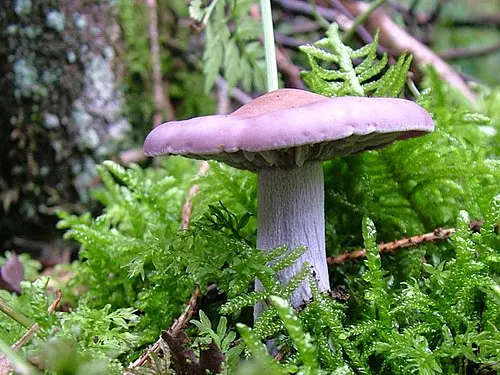 Annabel / CC BY-SA 3.0
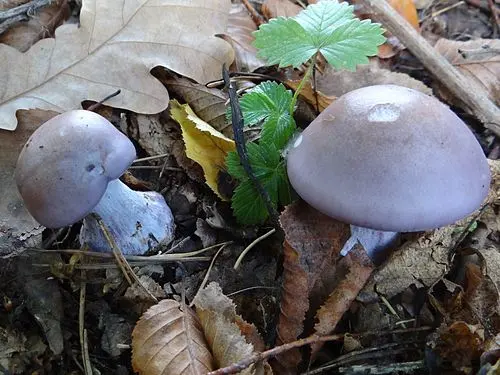 Jerzy Opioła / CC BY-SA 3.0
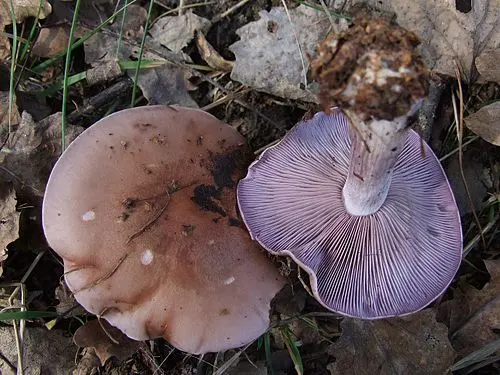 Jerzy Opioła / CC BY-SA 4.0
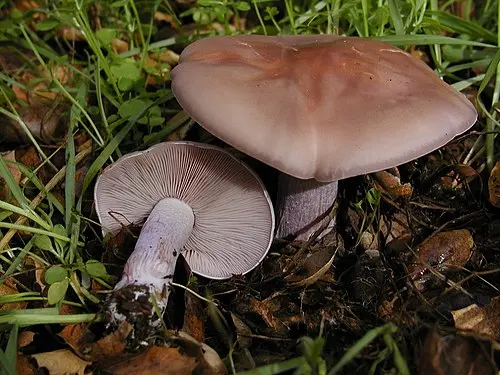 Nathan Wilson / CC BY-SA 3.0