

About this fungus
Wood Hedgehog is a fungus in the Hydnaceae family. Its habitat and field characteristics are summarised below.
A large, solid woodland mushroom with an uneven creamy white to pale buff cap. Its underside carries a dense layer of soft hanging spines instead of gills or pores. The cap often becomes lobed, wavy or joined to neighbouring caps as it expands.
What to check
Confirm soft, brittle spines about 2 to 6 mm long that run at least a short way down the stem, together with firm white flesh, no ring or volva and a white spore print. Large size, pale colour and little or no staining help separate the strict European species, but recent research recognises many similar Hydnum species. Microscopic characters or DNA may be needed for a species-level identification.
Variation
Caps are usually creamy white, pale buff or light ochre, with irregular pits and undulations. Age or handling may produce faint orange or reddish marks, but staining is not reliable by itself. Young caps are convex with an inrolled edge; mature caps can become flat, shallowly depressed, broadly scalloped or fused in crowded groups.
Lookalikes
Hydnum rufescens is generally smaller and more orange, with spines that stop at the stem or only narrowly attach rather than running clearly down it. European Hydnum magnorufescens stains more strongly, while H. ellipsosporum has darker orange colours and different spores. Under current DNA-informed definitions H. repandum is European; similar North American mushrooms include H. washingtonianum, H. subolympicum and several other regional species. The toothed underside identifies the general group more readily than it identifies this exact species.
Habitat and range
An ectomycorrhizal species growing on soil among moss, leaf litter or needles in European broad-leaved and coniferous woodland, particularly with beech and spruce in published accounts. It may fruit singly, in groups or in broad rings, mainly from summer into late autumn. Older reports from North America and Asia often used H. repandum for related species that have since been separated by DNA research.
Food safety
Choice edible.
Use this profile to learn what to examine and compare, not as proof that a mushroom is safe to eat. Check the whole specimen and every important lookalike before reaching an identification.
Photographs
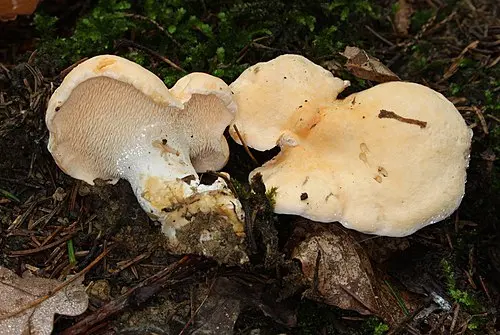 H. Krisp / CC BY 3.0
Species to compare
Similar mushrooms to compare against: