

About this fungus
Woolly Milkcap is a fungus in the Russulaceae family. Its habitat and field characteristics are summarised below.
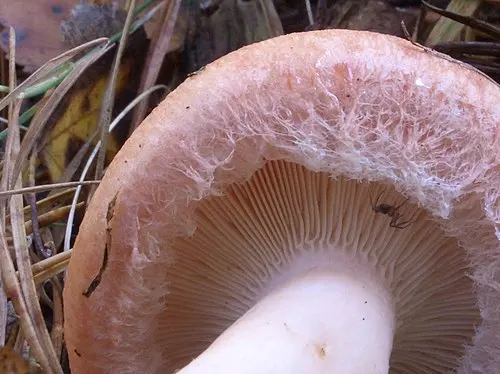
A pink to salmon-coloured milkcap with darker concentric zones and a conspicuously shaggy edge. Young caps are convex with a strongly rolled-in margin. They flatten and develop a shallow central depression as they expand. The pale pink gills and stem have no ring.
What to check
The combination of a woolly pink cap margin, darker rings on the cap and growth with birch is particularly useful. Damage to a gill releases white or cream latex that remains white as it dries. Look for crowded gills that run a short distance down the stem and a pale cream spore print.
Variation
The woolliness is most obvious on young, sheltered caps and can become flattened by rain or wear away with age. Older caps are flatter, less strongly zoned and often paler. The cap may range from pale buff-pink to a stronger salmon or pink-orange, while the central zones are usually darker.
Lookalikes
Downy Milkcap, Lactarius pubescens, also grows with birch and has a woolly margin, but its cap is usually much paler cream or buff and lacks the stronger pink tones. Saffron Milkcaps can share orange-pink colours, but their latex is orange or carrot-coloured rather than white. Check several features because weathered specimens can lose much of their woolly appearance.
Habitat and range
A mycorrhizal partner of birch, found on the ground in woodland, parks, heaths and grassy woodland edges. It is often associated with damp, acidic soil. Reports span Europe, northern Africa and parts of Asia, while closely related or varietal populations are also reported from North America.
Food safety
Poisonous.
Photographs
 Jomo / Public Domain