

About this fungus
Yellow Knight is a fungus in the Tricholomataceae family. Its habitat and field characteristics are summarised below.
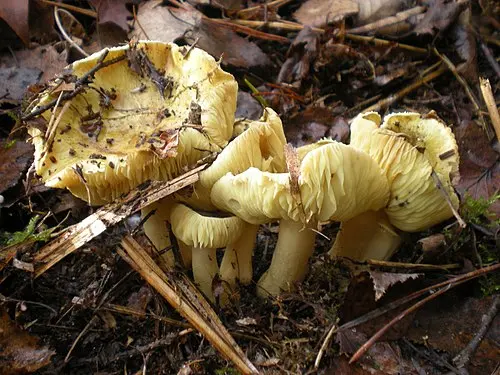
A solid late-season woodland mushroom whose cap, gills and stem all carry yellow tones. The cap is usually lemon-yellow to greenish-yellow around the edge, with a darker olive-brown or reddish-brown centre that may be finely fibrous or scaly. Its moist surface is slightly sticky and often arrives decorated with sand, pine needles or leaf fragments.
What to check
Look for crowded lemon to sulphur-yellow gills with a notch where they meet the stem, a white spore print and a sturdy yellow or pale yellow stem with no ring or volva. The cap starts rounded or convex, often with a low umbo, then broadens, becomes wavy and may finish almost flat or shallowly depressed. The pale flesh does not show a strong colour change when cut. Odour is usually mild, mealy or cucumber-like and is less useful than the combination of yellow gills, notched attachment, white spores and pine habitat.
Variation
Young caps can be bright lemon or greenish yellow with only a small darker centre. In older, drier or weathered specimens the brown or olive area may spread until the cap looks much duller, while the gills generally keep a clearer yellow tone. Sand and litter commonly stick to the cap and can hide its fibres. The traditional name covers a difficult species complex, so collections from different trees or continents may not all represent the same genetic species.
Lookalikes
Sulphur Knight, Tricholoma sulphureum, is usually more uniformly sulphur-yellow, has more widely spaced gills and a powerful coal-gas or tar-like smell. Tricholoma sejunctum can share a yellow or olive cap, but normally has strong dark radial fibres and much paler gills and stem. Grey Knight, Tricholoma portentosum, has a greyer radially streaked cap and whitish to grey gills that may only become yellowish with age. Tricholoma frondosae and other members of the Yellow Knight complex can be inseparable from photographs; tree association, microscopy and sometimes DNA are needed. A yellow-green Deathcap has white rather than yellow gills and carries both a ring and a sac-like volva at the base.
Habitat and range
Mycorrhizal and most strongly associated with pine, especially on acidic, nutrient-poor sandy soil. It can fruit singly, scattered or in groups, often partly buried in needle litter. European fruiting is mainly from autumn into early winter and may continue after light frost. Reports span Europe, Asia and North America, but the modern Yellow Knight complex contains cryptic species and North American records should not automatically be assumed to be genetically identical to European Tricholoma equestre.
Food safety
Poisonous. Serious or fatal poisoning has been reported.
Photographs
 Aorg1961 / CC BY-SA 4.0