
About this fungus
Yellow Stainer is a fungus in the Agaricaceae family. Its habitat and field characteristics are summarised below.
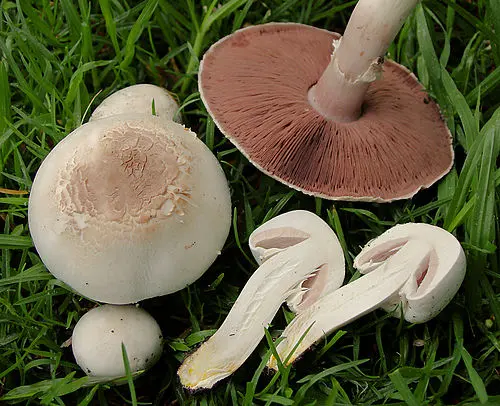
A white to cream Agaricus of lawns, parks and disturbed ground, often found in groups or rings. Young caps can look rounded, blocky or almost flat-topped before becoming convex and then broadly flat. Older caps may turn greyish or develop a pale brown centre. Its most famous feature is a local chrome-yellow reaction when bruised or cut, especially in the swollen stem base, rather than an overall yellow cap.
What to check
Lift the whole mushroom so the stem base is present, then cut through the base and watch promptly for vivid chrome-yellow staining that later turns brown. Check for free, crowded gills that begin whitish, become pink and finally dark chocolate-brown, a dark brown spore print, and a large persistent skirt-like ring with a thick edge. There is no volva. A phenolic smell compared with ink, iodine, carbolic soap or kerosene is helpful when present, especially from the cut base or during cooking. Neither clue is infallible: wet or old specimens may stain weakly or only briefly, and the smell can be faint or undetectable, so the absence of either does not establish an edible Agaricus.
Variation
Fresh young mushrooms often give the clearest yellow reaction, while older or rain-soaked specimens can show much less. The stain may fade within seconds or age brown. Research on Australian collections found that visible staining intensity did not reliably predict phenol concentration. Phenol also varied between cap and stem, young and mature mushrooms, and lawn and woody-mulch collections. This helps explain why colour, smell and reported effects are not identical in every encounter.
Lookalikes
Horse Mushroom, Agaricus arvensis, may yellow slowly and usually has a sweeter anise or almond smell, but smell alone is not a safe separator. Field Mushroom, Agaricus campestris, lacks the rapid chrome-yellow stem-base reaction and generally has a less substantial ring. Agaricus moelleri, Agaricus placomyces and other members of the yellow-staining group can also smell phenolic, stain yellow and cause illness; close species may need microscopy or DNA. A Deathcap has persistently white gills, white spores and a sac-like volva, unlike the pink-to-brown gills, dark spores and volva-free base of this species.
Habitat and range
Saprobic in lawns, gardens, parks, road verges, hedges, nutrient-rich disturbed soil and woody mulch, with occasional records from open or thin woodland. It fruits singly, scattered, in groups, clusters or arcs. It is widespread in temperate regions, including Europe and North America, and has been introduced to Australia. Fruiting season varies with local climate, commonly running from summer into autumn in cooler regions and through the milder months in warmer ones.
Food safety
Poisonous.
Photographs
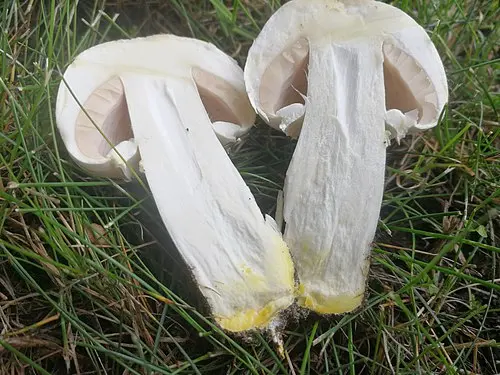 Tomasz Sobczak / CC BY-SA 4.0
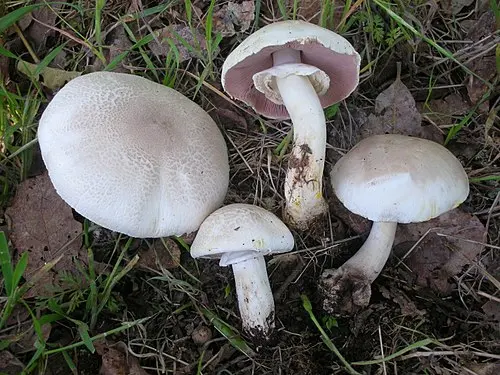 Ron Pastorino (Ronpast) / CC BY-SA 3.0