

About this fungus
Yellow Swamp Brittlegill is a fungus in the Russulaceae family. Its habitat and field characteristics are summarised below.
A bright lemon-yellow brittlegill of wet birch ground, with white to pale cream gills and flesh that slowly becomes grey where bruised, cut or aged.
What to check
Check the gradual greying of the white flesh and stem, pale gills that can become light yellow, a light ochre spore print, and the close link with birch on wet mossy ground. There is no ring or volva. These characters together are useful, but microscopy may be needed where other yellow Russula species overlap.
Variation
Caps range from vivid lemon-yellow to golden or dull ochre-yellow as they age and weather. The greying reaction may be slow and becomes clearer on handled or older tissue, so a fresh specimen can look cleaner and whiter than a mature one.
Lookalikes
Ochre Brittlegill, Russula ochroleuca, and other yellow Russula species can resemble it. The combination of wet birch habitat, greying flesh and ochre print is more informative than cap colour alone. Regional species concepts and microscopy matter when that combination is incomplete.
Habitat and range
Ectomycorrhizal mainly with birch on damp woodland edges, heaths, moors, bogs and sphagnum-rich ground near water. Aspen associations are also reported in North America. The ecological clue carries across regions, but similar local yellow species must still be considered.
Food safety
Edible and good.
Use this profile to learn what to examine and compare, not as proof that a mushroom is safe to eat. Check the whole specimen and every important lookalike before reaching an identification.
Photographs
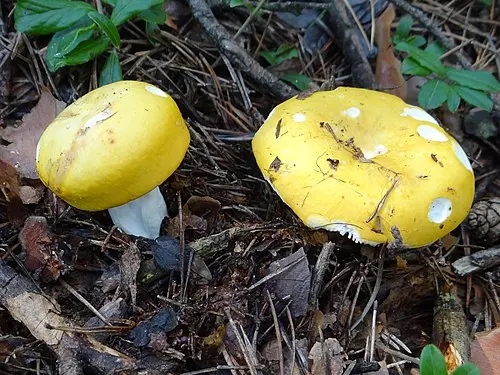 Jerzy Opioła / CC BY-SA 4.0
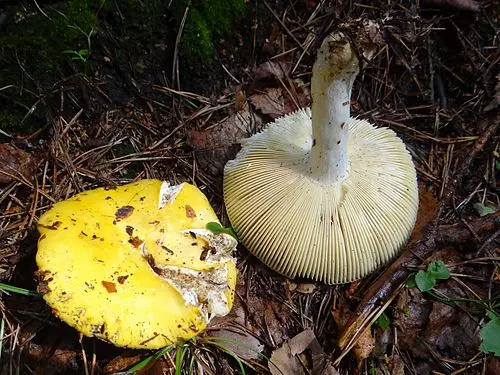 Jerzy Opioła / CC BY-SA 4.0