

About this fungus
Yellowdrop Milkcap is a fungus in the Russulaceae family. Its habitat and field characteristics are summarised below.
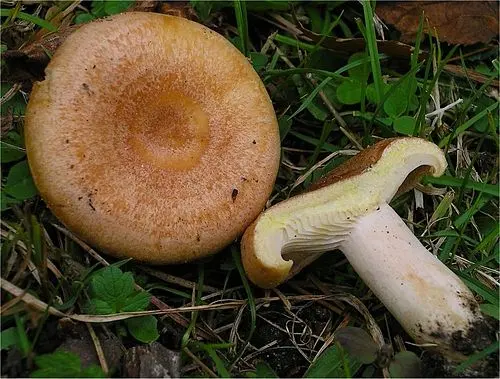
A pale salmon, pink-buff or cinnamon milkcap with faint darker rings and watery-looking blotches. The cap begins convex, then flattens and develops a shallow funnel. Its most memorable feature is not the cap colour but the bright yellow droplets that appear when the pale gills are damaged.
What to check
Damage to the gills releases white latex that quickly turns sulphur yellow in the air. The cut flesh also yellows. Check for crowded cream to orange-buff gills, a smooth pale stem without a ring and growth with oak or another broadleaf host.
Variation
The darker cap zones may be obvious, faint or almost absent. Dry or older caps can look browner and less pink, while wet caps may appear slightly greasy. Fresh gill damage shows the clearest yellow latex; older droplets and bruised flesh may look duller.
Lookalikes
Oakbug Milkcap, Lactarius quietus, also grows with oak but its latex remains cream-white rather than turning yellow. Several other milkcaps have yellowing latex. In North America, Lactarius maculatipes has pitted marks on the stem, while Lactarius vinaceorufescens is usually associated with conifers and develops reddish gill stains. Orange Saffron Milkcaps release orange rather than white latex.
Habitat and range
An ectomycorrhizal species most strongly associated with oaks in broadleaf woodland, parks and avenues. It is often reported from acidic, sandy or loamy soil. The species is widespread in Europe and is also reported from northern Africa and parts of North America, where similar yellow-latex milkcaps must be considered.
Food safety
Poisonous.
Photographs
 Irene Andersson / CC BY-SA 3.0