

About this fungus
Amber Jelly Fungus is a fungus in the Auriculariaceae family. Its habitat and field characteristics are summarised below.
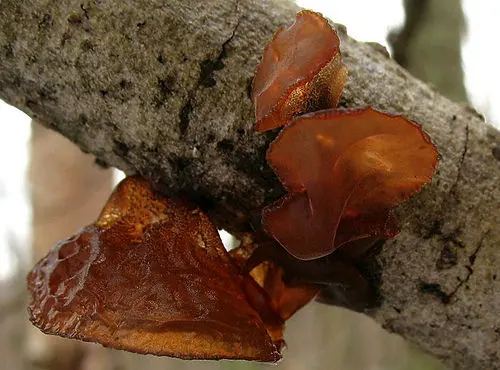
A firm but gelatinous amber-brown jelly fungus forming separate fruit bodies on dead hardwood twigs and branches. European examples are often broadly conical, cup-like or drooping with a pinched central attachment, while North American descriptions also include more deeply lobed and ridged forms.
What to check
Look for discrete, hairless fruit bodies attached to the wood at one central point, sometimes by a very short stem-like base. The fertile upper surface is smooth and shiny, while the underside is duller. A white spore print supports the identification. Fruit bodies can shrink and darken in dry weather, then swell and resume spore release after rain or heavy dew.
Variation
Fresh fruit bodies range from amber and orange-brown to dark brown or purplish brown. Shape changes with age, moisture and region. European willow collections are commonly conical, truncated or pendulous and usually 1 to 3 cm wide. North American accounts describe fruit bodies up to 4 cm wide with broad depressions separated by ridges, often clustered but remaining individually separable.
Lookalikes
Descidia repanda, formerly Exidia repanda, is usually rounder and button-like and is particularly associated with birch. Exidia glandulosa and Exidia nigricans are darker, blackish and more irregular or fused, so colour alone is not enough to separate them. Tremella mesenterica is brighter yellow and forms a more folded, brain-like mass. Regional field guides and microscopic characters may be needed where forms overlap.
Habitat and range
A saprotrophic fungus on dead hardwood twigs and branches. European accounts strongly associate it with willow, on attached or fallen wood, and place its main season from late autumn to early spring. North American accounts report it especially from recently fallen oak and other hardwood sticks from spring into autumn. These regional differences should be considered when identifying a collection.
Food safety
Edibility is uncertain or disputed.
Photographs
 Irene Andersson / CC BY-SA 3.0
Species to compare
Similar mushrooms to compare against: