
About this fungus
Bear's Head Tooth is a fungus in the Hericiaceae family. Its habitat and field characteristics are summarised below.
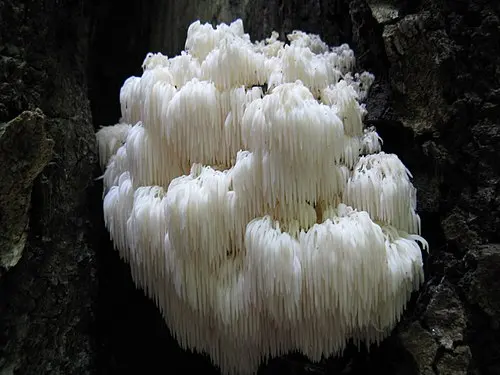
A large white eastern North American tooth fungus with a branched framework carrying dense tufts of long hanging teeth. It often forms a heavy cascading mass from dead hardwood or a wound on a living tree.
What to check
Confirm true internal branching with long teeth gathered in clusters at branch tips and sides. Note the hardwood substrate and eastern North American location. There is no ordinary cap, gills, stem, ring or volva. A close-up of teeth alone cannot establish the species because the overall architecture is essential.
Variation
Young fruit bodies are white and compact, sometimes hiding the branching. Expanded fruit bodies show clearer tiers and curtains of teeth. Age, drying or damage turns the surface cream, yellow or brown.
Lookalikes
Hericium coralloides has a more open, lacy framework with short teeth distributed along the branches. Hericium erinaceus and newly separated regional relatives form a more nearly unbranched cushion. Hericium abietis is a western North American conifer species. Region and substrate prevent many naming errors.
Habitat and range
Saprotrophic or weakly parasitic on broadleaved wood in eastern North America, including fallen logs, standing dead trees and wounds on living hardwoods. Older reports from western North America should be checked against Hericium abietis and other regional species.
Food safety
Choice edible.
Use this profile to learn what to examine and compare, not as proof that a mushroom is safe to eat. Check the whole specimen and every important lookalike before reaching an identification.
Photographs
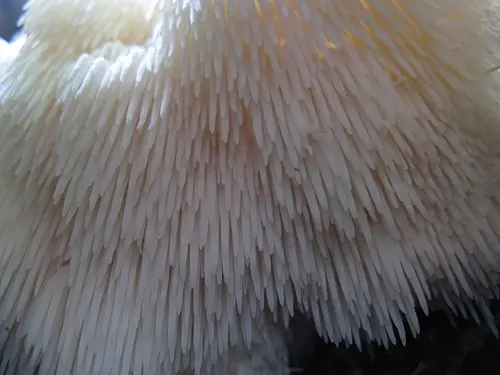 John Carl Jacobs / CC BY-SA 3.0
Species to compare
Similar mushrooms to compare against: