
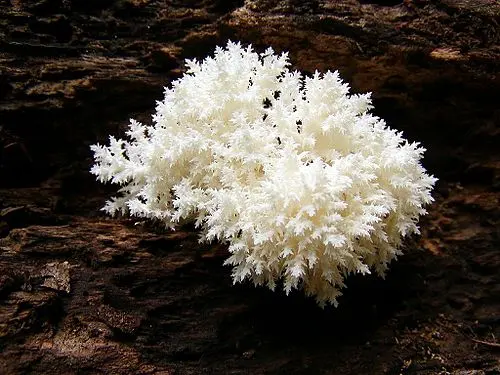
About this fungus
Coral Tooth Fungus is a fungus in the Hericiaceae family. Its habitat and field characteristics are summarised below.
A white, coral-like tooth fungus with an open network of slender branches. Short hanging teeth line the undersides of the branches as well as their tips, forming a delicate mass on dead wood.
What to check
Check for clearly branched growth, teeth usually no more than about 5 mm long along the branches, and a direct attachment to wood. There is no cap, gills, pores, ordinary stem, ring or volva. Branching pattern, spine length, substrate and region all matter, and difficult specimens may require spores or DNA.
Variation
Fresh growth is white and soft. Older fruit bodies become cream or yellow-brown, increasingly brittle, and less clearly separated into fine branches. Compact young growth can hide the open branching until viewed from several angles.
Lookalikes
Hericium americanum has longer teeth gathered in denser tufts on a branched frame and is centred in eastern North America. Hericium abietis grows on western North American conifers. Hericium erinaceus forms an unbranched cushion of long teeth. Microscopy may be needed where forms overlap.
Habitat and range
A wood-decay fungus found mainly on dead broadleaved trunks and large branches, especially beech and other mature hardwoods. Modern multilocus work supports occurrence across Europe, Asia and North America, although some regional diversity may remain unresolved. It is scarce or protected in parts of Europe.
Food safety
Edible and good.
Use this profile to learn what to examine and compare, not as proof that a mushroom is safe to eat. Check the whole specimen and every important lookalike before reaching an identification.
Photographs
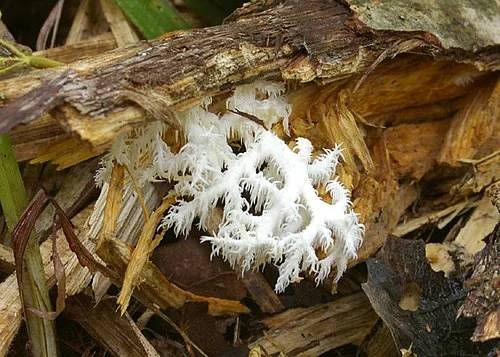 / CC BY 3.0
Species to compare
Similar mushrooms to compare against: