

About this fungus
Birch Knight is a fungus in the Tricholomataceae family. Its habitat and field characteristics are summarised below.
A brown woodland knight associated with birch, recognised by yellowish gills that develop brown spots and a ringless stem with yellow flesh inside. The cap is reddish brown with fine radial fibres and can become sticky in wet weather.
What to check
Check the nearby tree, the yellow gills with brown spotting, the distinctly yellow flesh inside the stem and the absence of a ring or volva. The gills are notched where they meet the stem. A flour-like smell may be present but is variable and should remain a supporting clue.
Variation
The cap ranges from yellow-brown to dark reddish brown and is often darker in the centre. Moist caps can look glossy, while dry caps appear matt and fibrous. Gill spotting and the yellow tones become clearer with age.
Lookalikes
Several brown Tricholoma species are difficult to separate in the field, including Tricholoma ustale and Tricholoma pessundatum. Tricholoma equestre is more yellow overall and normally keeps bright yellow gills without the same brown spotting. Host tree, internal stem colour and microscopy may all be needed. North American mushrooms given this name may represent other regional taxa.
Habitat and range
Ectomycorrhizal mainly with birch in damp woodland, scrub, bog edges and other birch-rich ground. Tricholoma fulvum is a European species concept; similar brown knights in North America and elsewhere should be assessed within their local flora.
Food safety
Edible.
Use this profile to learn what to examine and compare, not as proof that a mushroom is safe to eat. Check the whole specimen and every important lookalike before reaching an identification.
Photographs
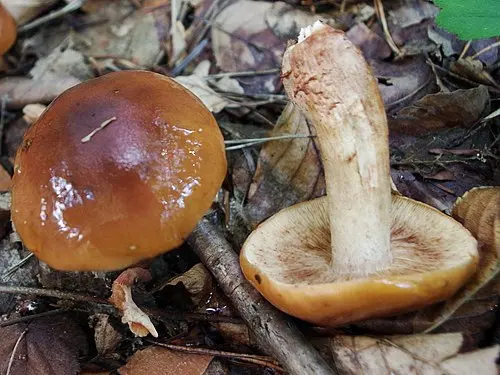 Jerzy Opioła / CC BY-SA 4.0
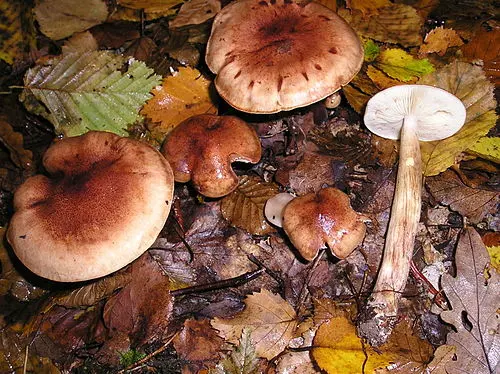 Strobilomyces / CC BY-SA 3.0
Species to compare
Similar mushrooms to compare against: