

About this fungus
Black-staining Polypore is a fungus in the Meripilaceae family. Its habitat and field characteristics are summarised below.
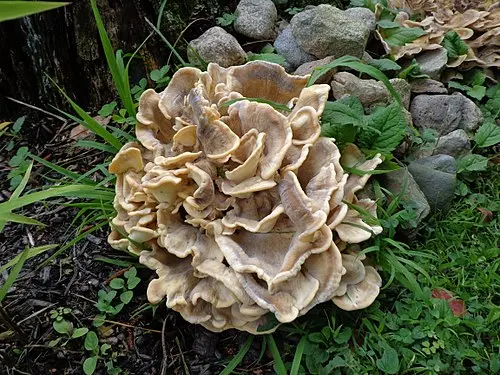
A very large rosette of overlapping fan-shaped caps growing from a shared branched base near a tree or stump. Young growth is whitish to cream or pale tan, then becomes brown and develops conspicuous dark brown to black bruising and ageing marks.
What to check
Look underneath for a white pore surface with very small round to angular pores rather than gills. Fresh pores, margins and cut tissue stain dark brown to black, although the reaction may be less clear on old dried material. Individual caps are fan-shaped or spoon-shaped with thin margins, and the whole cluster arises from a short thick branching base. The spore print is white and there is no ring or volva.
Variation
Young clusters can be almost white and relatively compact. The caps become ochre, tan or brown, often with radial streaks and concentric zones, while handling, damage and age create irregular black patches. A mature cluster can be much wider than any single cap, and very old specimens may be too uniformly dark for the staining reaction to stand out clearly.
Lookalikes
Hen of the Woods, Grifola frondosa, usually has many smaller grey-brown fronds, larger pores and no strong black bruising. Berkeley's Polypore, Bondarzewia berkeleyi, has thicker pale caps and larger pores but does not blacken strongly. The European Giant Polypore, Meripilus giganteus, is extremely similar; the app uses M. sumstinei for the North American concept, although major taxonomic databases still differ over whether the two should be combined.
Habitat and range
A parasite of living hardwoods and a decomposer of dead hardwood roots and stumps, producing a white rot. It is especially associated with oaks and commonly fruits on the ground at or near a tree base, sometimes from buried roots. It is widespread in eastern North America and much less frequently reported in the west. Clusters can return at the same site in later years.
Food safety
Edible.
Use this profile to learn what to examine and compare, not as proof that a mushroom is safe to eat. Check the whole specimen and every important lookalike before reaching an identification.
Photographs
 Clyde Elledge / CC BY-SA 3.0
Species to compare
Similar mushrooms to compare against: