
About this fungus
Hen Of The Woods is a fungus in the Grifolaceae family. Its habitat and field characteristics are summarised below.
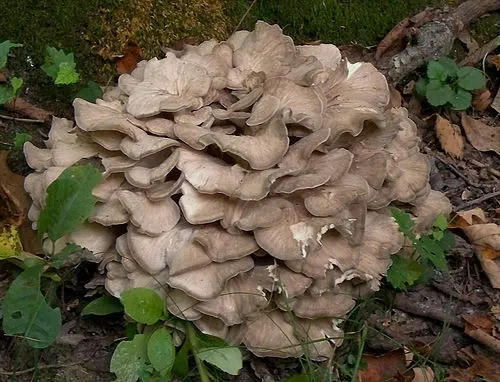
A substantial ruffled rosette growing on the ground at the base of a tree, especially an oak. Dozens of thin grey-brown, tan or olive fan-shaped caps arise from one pale repeatedly branched base, giving the cluster its familiar resemblance to a sitting hen's feathers.
What to check
Examine the underside for a white to cream pore surface rather than gills. The angular pores run down the branched stem structure and may become pale yellowish with age, but they do not rapidly bruise black. Individual caps are thin, spoon-shaped or fan-shaped with wavy margins. The flesh is white and normally remains unchanged when cut. The spore print is white, with no ring or volva anywhere in the cluster.
Variation
Clusters range from compact pale grey growth to broad dark grey-brown or olive rosettes, sometimes with faint concentric zones. Individual caps can yellow slightly as they age. Very pale or nearly white forms occur, and old clusters become leathery, yellowed and less clearly patterned. The whole fruit body is far larger than any one cap.
Lookalikes
Black-staining Polypore, Meripilus sumstinei in North America and M. giganteus in Europe, has larger individual fans, much smaller pores and a strong dark brown to black bruising reaction. Berkeley's Polypore, Bondarzewia berkeleyi, forms fewer, thicker pale caps. Umbrella Polypore, Polyporus umbellatus, has more distinct round caps on central branchlets. Sparassis species form ribbon-like folds with smooth fertile surfaces rather than true pores, and their tree hosts vary by species and region.
Habitat and range
Weakly parasitic on living oaks and other mature trees, and also able to decompose dead roots and stumps, causing a white butt rot. Fruit bodies usually appear on the ground at the base of the host or over buried roots and can return at the same site in later years. It occurs in Europe, Asia and North America, although frequency and host range vary regionally. Fruiting is usually from late summer into autumn in temperate climates.
Food safety
Choice edible.
Use this profile to learn what to examine and compare, not as proof that a mushroom is safe to eat. Check the whole specimen and every important lookalike before reaching an identification.
Photographs
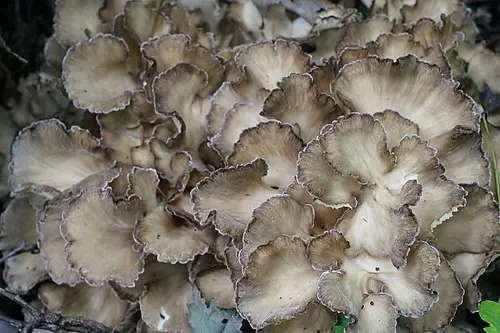 Davepd19 / CC BY-SA 3.0
Species to compare
Similar mushrooms to compare against: