
About this fungus
Giant Polypore is a fungus in the Meripilaceae family. Its habitat and field characteristics are summarised below.
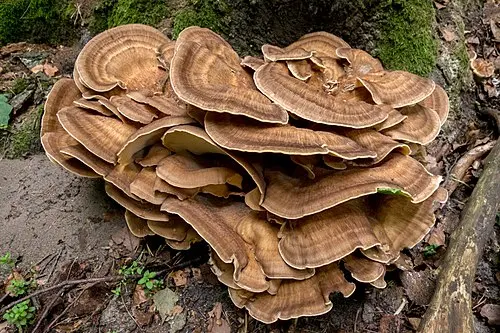
A massive rosette of overlapping fan-shaped brackets at the base of a broadleaved tree. A whole fruit body can spread close to a metre across, while each individual cap is much thinner.
What to check
The underside has a fine white to cream pore surface, not gills. Pressing or damaging fresh pores and flesh causes a grey-brown then black stain. The caps are concentrically zoned and arise in many tiers from a shared base.
Variation
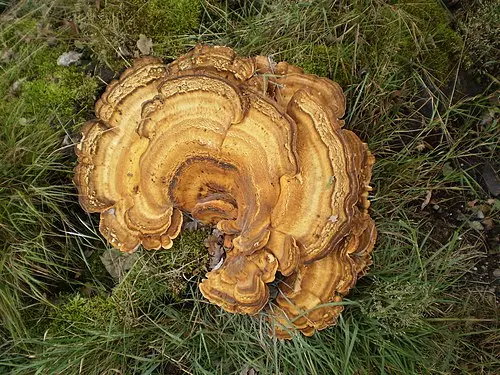
Young caps are pale cream to yellow-brown with soft margins. They darken through brown and become tougher with age, handling and drying. The speed and strength of blackening vary with freshness.
Lookalikes
Hen of the Woods has many smaller grey-brown fronds and does not blacken in the same way. Berkeley's Polypore has thicker pale caps and much larger pores. Chicken of the Woods is yellow to orange. In North America, the corresponding black-staining species is Meripilus sumstinei, not M. giganteus.
Habitat and range
Parasitic at the roots and lower trunk of living broadleaved trees, then able to continue on dead roots and stumps. Beech is a frequent European host, with oak, lime, elm, poplar and other trees also recorded. The strict species is European and western Asian rather than North American.
Food safety
Edibility is uncertain or disputed.
Photographs
 Apdency / Public Domain
Species to compare
Similar mushrooms to compare against: