
About this fungus
Blackening Brittlegill is a fungus in the Russulaceae family. Its habitat and field characteristics are summarised below.
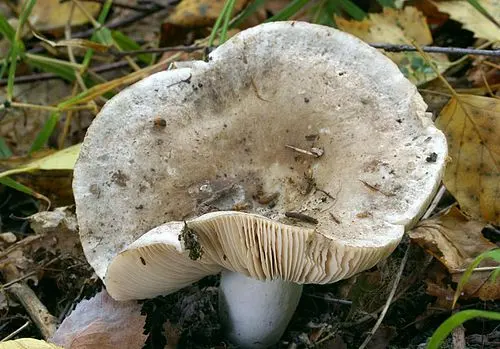
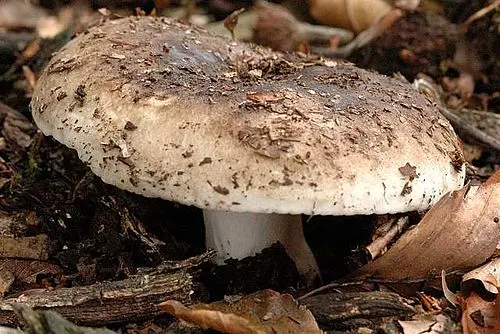
A large, firm brittlegill that begins dirty white to pale buff and develops a scorched grey-brown appearance. Its thick pale gills and stout brittle build are more useful than the expectation of dramatic blackening.
What to check
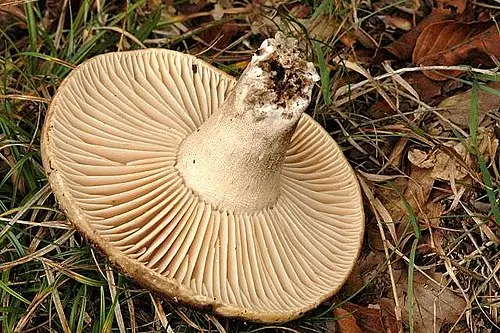
Look for firm brittle white flesh, close but not crowded pale gills with many shorter gills between them, a white spore print and a smooth ringless stem. Cut or bruised flesh changes slowly, often showing only faint pinkish or reddish tones before greying or darkening. Record the timing rather than judging the final colour alone.
Variation
Young caps can be whitish, then become buff, sepia, smoky grey-brown or blackish with age. The staining reaction is variable and may be much weaker than the common name suggests.
Lookalikes
Russula densifolia, R. nigricans, R. albonigra and other members of subgenus Compactae overlap strongly. Gill spacing, staining sequence, odour, microscopy and host association may all be needed, and recent European research has redrawn several species limits.
Habitat and range
A mycorrhizal woodland fungus associated with conifers, including pine and spruce. Reports from broadleaf woodland should be treated cautiously because recent European work found the strict species to be conifer-associated.
Food safety
Inedible.
Photographs
 James K. Lindsey / CC BY-SA 3.0
 James K. Lindsey / CC BY-SA 3.0
Species to compare
Similar mushrooms to compare against: