
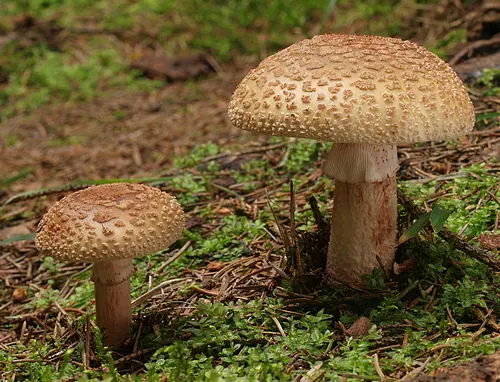
About this fungus
Blusher is a fungus in the Amanitaceae family. Its habitat and field characteristics are summarised below.
A robust woodland Amanita with a very variable cream, brown or pink-brown cap and irregular greyish veil patches. Damaged flesh, gills and insect tunnels slowly develop pink to wine-red staining, the feature behind its common name.
What to check
Inspect the whole mushroom, including the complete stem base. Look for reddening in fresh damaged flesh, crowded white gills that may spot pink, a white spore print, and a hanging ring that is usually grooved on its upper surface. The base is swollen but lacks a persistent sack or sharply rimmed collars. Slow or weak reddening is not enough on its own.
Variation
Cap colour ranges from almost white through yellow-brown, pink-brown and dark brown. Rain may wash away veil patches, rings can tear, and the reddish reaction varies in speed and strength. Pale forms can look strikingly unlike the usual brown Blusher.
Lookalikes
Panthercap, Amanita pantherina, is seriously poisonous and does not redden when damaged. It usually has white cap patches, a smooth upper ring and collar-like ridges above the bulb, but weather and damage can hide these features. Grey Spotted Amanita, Amanita excelsa, can also resemble a weakly reddening specimen. Use the complete combination and regional Amanita knowledge rather than one bruise mark.
Habitat and range
Ectomycorrhizal on woodland soil with broad-leaved trees and conifers, especially oak, beech, spruce and pine, and often common on acidic ground. The name Amanita rubescens is secure for the European species, while North American blushers form a complex that includes distinct named and unnamed taxa.
Food safety
Edibility is uncertain or disputed.
Photographs
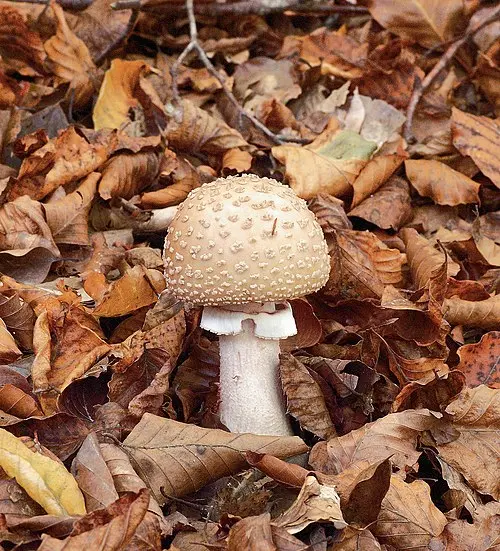 Danel Solabarrieta / CC BY-SA 2.5
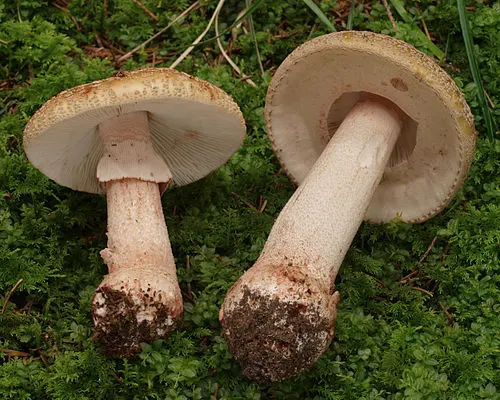 Andreas Kunze (Ak ccm) / CC BY-SA 3.0
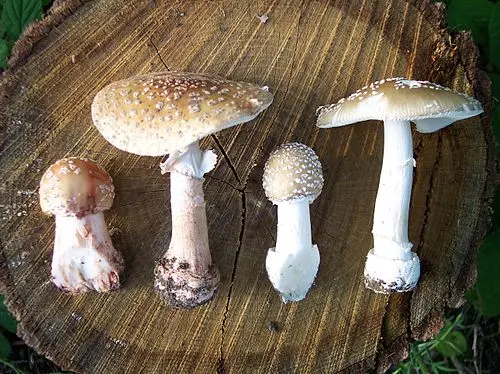 Toffel / CC BY-SA 3.0 (comparison: Blusher left, Panthercap right)
Species to compare
Similar mushrooms to compare against: