

About this fungus
Branching Oyster is a fungus in the Pleurotaceae family. Its habitat and field characteristics are summarised below.
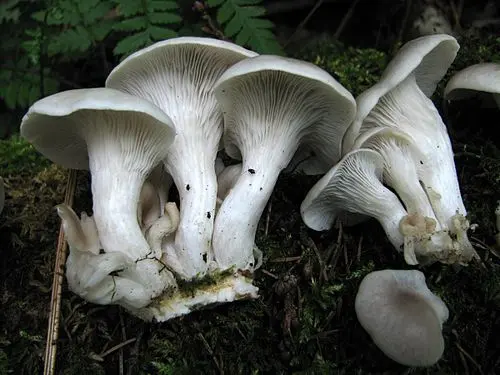
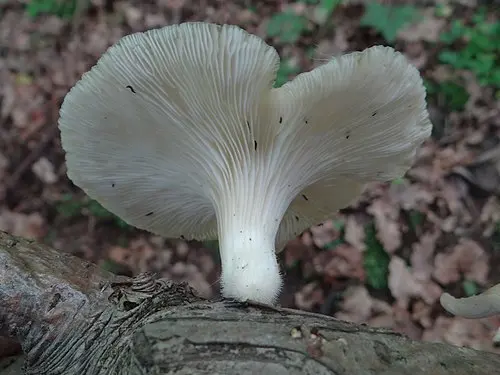
A pale oyster mushroom forming dense clusters from a shared branching base. The cream to ochre caps are often funnel-shaped, and their white gills run strikingly far down the stems.
What to check
Look beneath the cluster for deeply decurrent gills that fork and reconnect as they run down several stems into a common base. This network of gills and the branching cluster are stronger clues than cap colour. There is no veil, ring or volva.
Variation
Caps begin cream to pale ochre and can become darker ochre-brown with age. Crowded fruit bodies vary from fan-shaped to strongly funnel-shaped, while old cap edges may become wavy or split.
Lookalikes
Pleurotus ostreatus usually has less strongly decurrent gills and lacks the same branching shared base. Veiled Oyster, Pleurotus dryinus, has a felty cap and partial veil. Golden Oyster, Pleurotus citrinopileatus, is closely related but has brighter yellow caps. Regional Pleurotus may need microscopic or DNA study.
Habitat and range
Saprotrophic and sometimes weakly parasitic on dead, dying or wounded broadleaved trees, especially elm, beech and oak in European accounts. GBIF currently flags the name status as doubtful, while the UK Species Dictionary and molecular literature recognise Pleurotus cornucopiae, so the staged name is retained with that taxonomic caution.
Food safety
Edible.
Use this profile to learn what to examine and compare, not as proof that a mushroom is safe to eat. Check the whole specimen and every important lookalike before reaching an identification.
Photographs
 Iv Merlu (Merlu) / CC BY-SA 3.0
 Jerzy Opioła / CC BY-SA 4.0
Species to compare
Similar mushrooms to compare against: