

About this fungus
Oyster Mushroom is a fungus in the Pleurotaceae family. Its habitat and field characteristics are summarised below.
A substantial fan or oyster-shell-shaped mushroom growing from wood, usually in overlapping shelves. Smooth caps range from pale grey and buff to dark grey-brown, while the pale gills sweep down a short off-centre stem or meet the point of attachment directly.
What to check
Confirm thick white flesh, close pale gills running well down the stem, no veil or ring, and growth from wood. The spore print is white to pale lilac-grey. A lilac tint supports an oyster mushroom identification but does not by itself separate every Pleurotus species.
Variation
Cap colour overlaps widely within the oyster mushroom group. In temperate North America, Pleurotus ostreatus is usually the darker cold-season species, while Summer Oyster is often paler and fruits in warmer months. Those clues are useful together with the host but are not absolute. European accounts also record a broader fruiting season.
Lookalikes
Summer Oyster, Pleurotus pulmonarius, and Aspen Oyster, Pleurotus populinus, can look extremely similar; season, host and sometimes microscopy or DNA are needed. Veiled Oyster, Pleurotus dryinus, has a dry hairy or frosted cap and a temporary veil that may leave a ring. Angel's Wings, Pleurocybella porrigens, is thinner, pure white and usually on conifer wood. Omphalotus species are orange, more clearly stemmed and dangerous to eat.
Habitat and range
Saprobic and sometimes weakly parasitic, causing white rot on living, dying and dead wood. It is found mainly on broad-leaved trees, including beech and oak in Europe, but can use many hardwoods and only occasionally conifers. Fruiting time varies with climate and region.
Food safety
Choice edible.
Use this profile to learn what to examine and compare, not as proof that a mushroom is safe to eat. Check the whole specimen and every important lookalike before reaching an identification.
Photographs
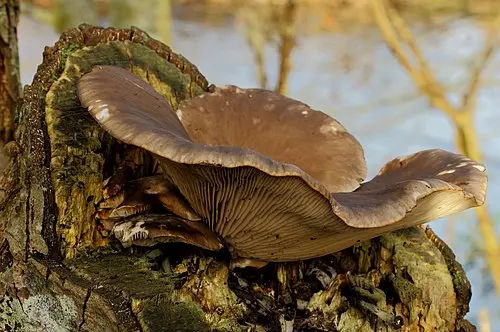 Dominicus Johannes Bergsma / CC BY-SA 4.0
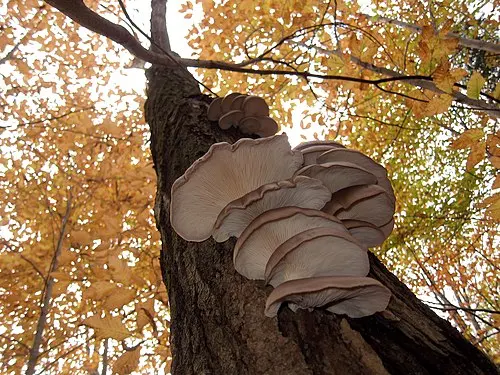 Charl de Mille-Isles / CC BY 2.0
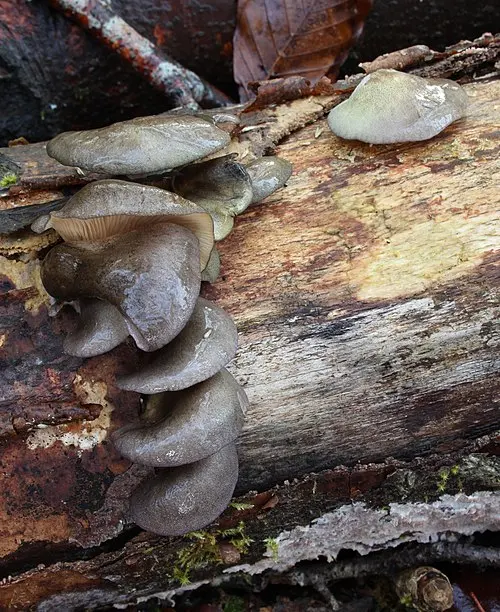 Holger Krisp / CC BY 3.0
Species to compare
Similar mushrooms to compare against: