
About this fungus
Summer Oyster Mushroom is a fungus in the Pleurotaceae family. Its habitat and field characteristics are summarised below.
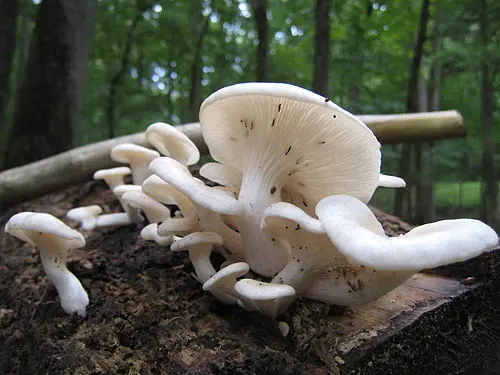
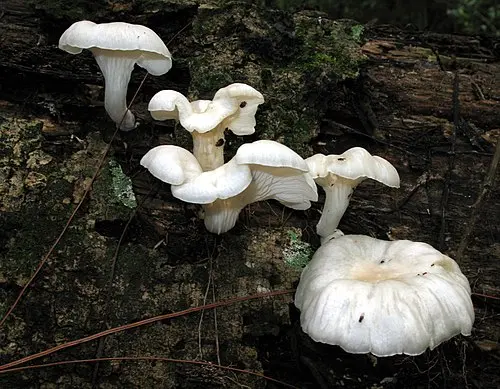
A pale oyster mushroom that forms overlapping shelves on wood. The white to cream caps are usually thin-fleshed, with a short lateral stem or no obvious stem, and it is most often found during warmer weather.
What to check
Look for crowded white gills running down a short, off-centre stem and for clustered growth directly from wood. There is no ring or volva. Pale colour and warm-season fruiting support the name but do not prove it, because oyster mushrooms vary greatly and several species overlap.
Variation
Caps range from white to cream or pale tan and may yellow slightly with age. Shape changes where shelves press against one another. Warm-season fruiting is typical, but local climate and other Pleurotus species make season only a supporting clue.
Lookalikes
Pleurotus ostreatus and other regional oyster mushrooms can be extremely similar; reliable separation may need microscopic or DNA evidence. Angel Wings, Pleurocybella porrigens, is thinner and usually grows on conifer wood without a substantial stem. Crepidotus species have a brown spore print rather than white.
Habitat and range
Saprotrophic and sometimes weakly parasitic on dead, dying or wounded wood, especially broadleaved trees. Reports from conifer wood also occur. Its exact species boundaries and regional forms are still being refined, so apparent Summer Oysters outside well-studied areas deserve caution.
Food safety
Edible and good.
Use this profile to learn what to examine and compare, not as proof that a mushroom is safe to eat. Check the whole specimen and every important lookalike before reaching an identification.
Photographs
 Richard Kneal / CC BY-SA 3.0
Species to compare
Similar mushrooms to compare against: