

About this fungus
Brick Cap is a fungus in the Hymenogastraceae family. Its habitat and field characteristics are summarised below.
A sturdy tuft-forming mushroom that crowds over hardwood stumps and buried roots. Each cap is darkest brick red or chestnut at the centre and fades towards a cream, buff or pinkish margin. Young caps may carry pale fibrous veil scraps around the edge, while older clusters often become irregular as the fruit bodies press against one another.
What to check
Look for crowded gills attached to the stem. They begin whitish or cream, pass through grey or olive-grey and become purple-grey to dark purple-brown as the spores mature. The stem is pale near the top and darkens to ochre or reddish brown below, with a fibrous veil that usually leaves only a faint ring zone rather than a complete ring. The spore print is purple-brown. Confirm the hardwood substrate, cap colour pattern, gill development and spore colour together.
Lookalikes
Sulphur Tuft, Hypholoma fasciculare, is usually brighter sulphur yellow with greenish-yellow young gills, although old specimens can become much duller. Conifer Tuft, Hypholoma capnoides, usually grows on conifer wood and has smoky grey gills without the same brick-red cap centre. Funeral Bell, Galerina marginata, can also form brown clusters on wood and contains amatoxins; it has a rusty to cinnamon-brown spore print rather than purple-brown. Veils and rings can disappear with age, so substrate or one colour is not enough on its own.
Habitat and range
Saprotrophic on dead hardwood, especially stumps, fallen logs and buried roots. Oak is a frequent substrate, but other broad-leaved trees are used. It fruits in tight clusters, smaller tufts or occasionally alone, mainly from late summer through autumn and sometimes after frost in North America. The species is recorded across Europe, temperate Asia and North America, with regional differences in abundance and naming tradition.
Food safety
Edibility is uncertain or disputed.
Photographs
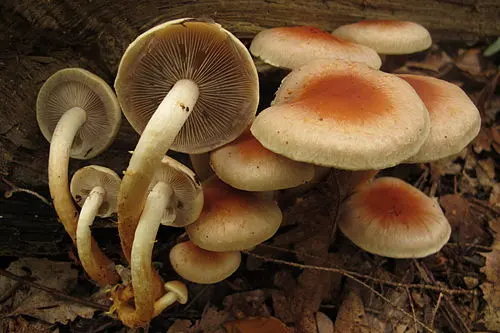 Walt Sturgeon (Mycowalt) / CC BY-SA 3.0
Species to compare
Similar mushrooms to compare against: