
About this fungus
Sulphur Tuft is a fungus in the Strophariaceae family. Its habitat and field characteristics are summarised below.
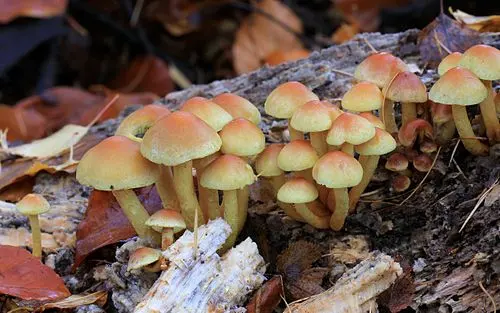
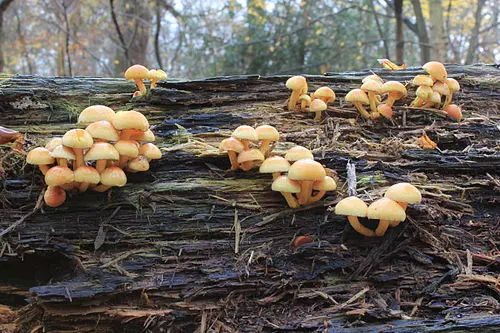
Dense tufts of small sulphur-yellow mushrooms crowd a stump, buried root or fallen trunk. Fresh caps usually have bright yellow to yellow-green margins around warmer orange-tan or orange-brown centres, while older clusters develop smoky olive gills that contrast strongly with the caps.
What to check
Start with the wood-growing cluster, then turn over fruit bodies of different ages. The close gills begin sulphur-yellow or greenish-yellow, become olive or smoky green, and finally darken under purple-brown spores. Caps broaden from rounded or bell-shaped to convex and nearly flat, sometimes with a low central bump. A thin young veil may leave pale fragments on the cap edge or a faint fibrous, spore-darkened zone high on the stem, but there is no persistent ring and no volva.
Variation
The cap centre may be yellow-orange, tan, orange-brown or occasionally reddish-brown, especially in young or dry fruit bodies, while the edge is usually the brighter sulphur-yellow part. Cap-edge veil fragments soon disappear. Stems begin yellow and can develop rusty or reddish-brown staining upwards from the base. Very young gills may look more yellow than green, and very old ones can look grey, purple-brown or almost black because of the mature spores.
Lookalikes
Conifer Tuft, Hypholoma capnoides, usually has pale grey to smoky grey young gills without the distinctive greenish stage and is especially associated with conifer wood. Brick Tuft, Hypholoma lateritium, has a more brick-red centre and paler young gills. Sheathed Woodtuft, Kuehneromyces mutabilis, is browner and normally has a distinct ring with a darker, scaly stem below it. Funeral Bell, Galerina marginata, can also grow on the same wood and is potentially fatal; it has a rusty-brown rather than purple-brown spore print. No single cap colour or substrate safely separates all of these species, and difficult collections may need microscopy or DNA.
Habitat and range
Saprotrophic on dead wood, including stumps, fallen trunks and buried roots of broadleaf trees and conifers. It usually fruits in tight clusters, sometimes in large runs along one log, and can appear from spring into late autumn or during mild winter weather. The name is used widely across temperate regions, but multilocus research shows that very similar-looking H. fasciculare and H. subviride lineages have been confused. European material aligns well with H. fasciculare, while users elsewhere should also consult regional treatments.
Food safety
Poisonous.
Photographs
 Borch3kawki / CC BY-SA 3.0
 Stu's Images / CC BY-SA 3.0
Species to compare
Similar mushrooms to compare against: