
About this fungus
Common Ink Cap is a fungus in the Psathyrellaceae family. Its habitat and field characteristics are summarised below.
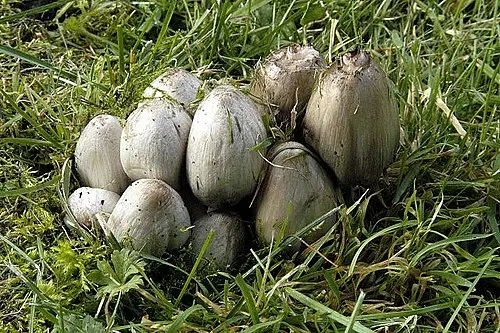
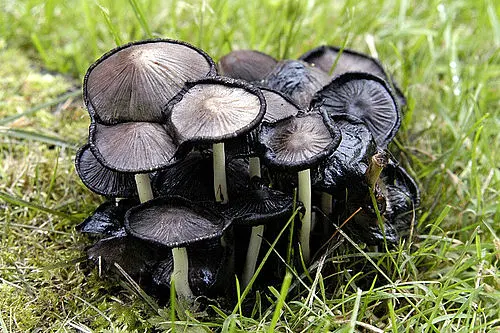
A clustered grey inkcap whose young egg-shaped caps expand into bells, then blacken and dissolve from the edge into an inky liquid. Groups often appear to grow from grass or soil, although buried wood or old roots are usually feeding them below the surface.
What to check
Look for a 3 to 10 cm lead-grey or grey-brown cap with a finely scaly or slightly scruffy centre and a faintly lined margin. The crowded gills begin whitish, pass through grey or brownish tones, then turn black and liquefy. They may be free or narrowly attached. The white fibrous stem is hollow and has no dependable skirt-like ring, although a low veil zone can sometimes remain. The spore print is black. Use young and middle-aged mushrooms for the structural checks because mature caps quickly lose their shape.
Variation
Very young caps can be almost white and tightly egg-shaped. They become greyer or browner as they expand, while the margin splits, curls upward and finally collapses as the gills dissolve. A cluster can therefore contain pale closed caps, grey bells and almost black remains at the same time.
Lookalikes
Mica Cap, Coprinellus micaceus, is usually smaller and warmer tawny-brown, with glistening granules on fresh young caps, although rain can remove them. Coprinopsis romagnesiana has more conspicuous brown scales and a more strongly developed veil. Shaggy Inkcap, Coprinus comatus, is taller and shaggy-scaled rather than smooth grey. Deliquescence identifies the wider inkcap group, not this species by itself, so cap texture, growth form and substrate still matter.
Habitat and range
Saprotrophic on decaying wood, commonly old roots, buried timber and the bases of stumps. It fruits in close groups or dense clusters in woodland, gardens, parks, verges, grassland and other disturbed places across temperate regions. Apparently terrestrial groups often reveal buried wood when the site is examined carefully.
Food safety
Edibility is uncertain or disputed.
Photographs
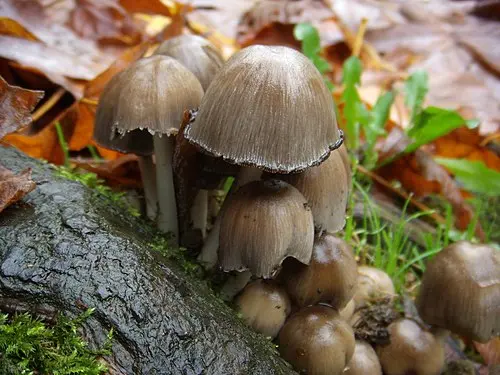 Media res / CC BY-SA 3.0
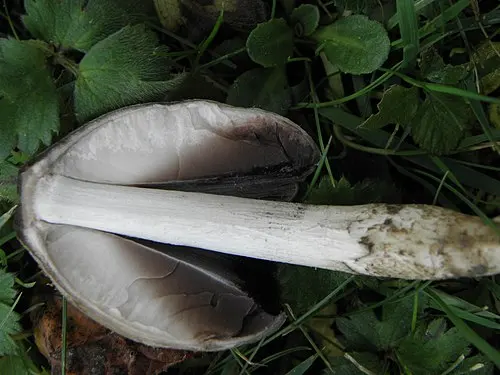 Rob Hille / CC BY-SA 3.0
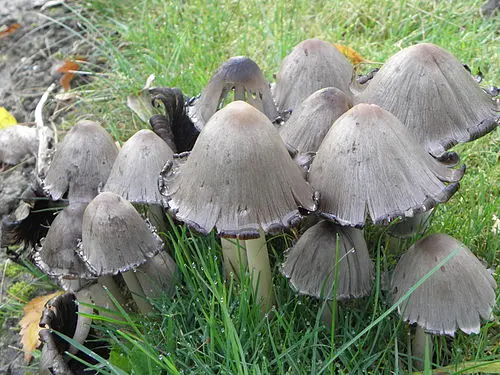 Rob Hille / CC BY-SA 3.0
 James Lindsey / CC BY-SA 3.0
Species to compare
Similar mushrooms to compare against: