
About this fungus
Copper Spike is a fungus in the Gomphidiaceae family. Its habitat and field characteristics are summarised below.
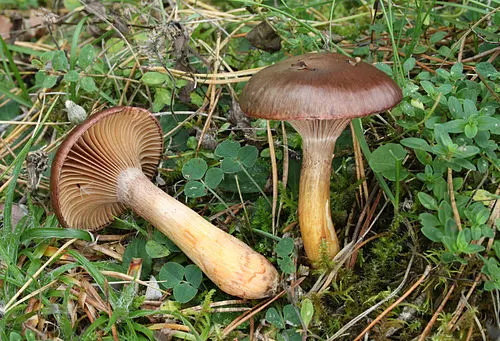
A sturdy European pine-associated mushroom with a copper-brown to vinaceous cap, thick gills running well down the stem, and a yellow stem base. The wet cap is sticky but dries to a polished metallic sheen.
What to check
Look for thick, deeply decurrent gills that begin grey-white or dull olive-buff and darken towards dirty purple or brown as the spores mature. The spore print is very dark smoky olive to almost black. Check the coppery viscid cap, reddish upper stem, yellow base and nearby pine. A short-lived cobwebby veil may leave fibres or a dark zone, but there is no durable membranous ring and no volva.
Lookalikes
Slimy Spike, Gomphidius glutinosus, usually has a greyer and much more glutinous cap and is associated mainly with spruce. Several European Chroogomphus species overlap in colour and shape and may require spore, cystidial and cap-surface microscopy. North American mushrooms formerly called C. rutilus are now placed in species such as C. ochraceus and C. vinicolor. The European name should therefore not be transferred to a North American photograph from appearance alone.
Habitat and range
Found in coniferous woodland, grass and open ground beneath pines, particularly two-needled pines such as Scots pine. Some European accounts include occasional spruce records, although recent work shows that host and regional taxonomy are more complicated than older field guides suggested. Chroogomphus can also interact with Suillus and Rhizopogon fungi associated with the same trees.
Food safety
Edible.
Use this profile to learn what to examine and compare, not as proof that a mushroom is safe to eat. Check the whole specimen and every important lookalike before reaching an identification.
Photographs
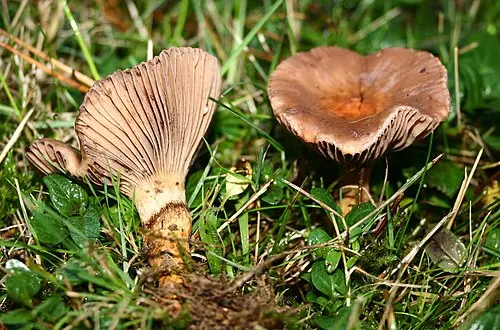 Strobilomyces / CC BY-SA 3.0
Species to compare
Similar mushrooms to compare against: