
About this fungus
Slimy Spike is a fungus in the Gomphidiaceae family. Its habitat and field characteristics are summarised below.
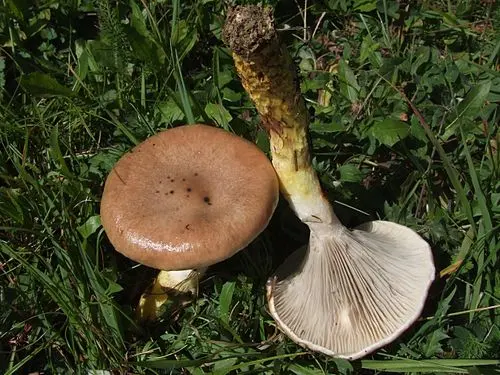
A sturdy, very slimy spike mushroom with a grey, violet-grey or brown cap. Beneath it are widely spaced gills rather than pores, and the lower stem is usually bright yellow.
What to check
Look for thick, widely spaced gills running well down the stem. They begin whitish, then darken through grey to almost black as the spores mature. Young mushrooms have a transparent glutinous veil between the cap edge and stem. This usually collapses into a dark, sticky ring zone rather than leaving a firm ring. There is no volva.
Variation
Cap colour ranges from violet-grey to brown and can become paler with age. The coating is most obvious when wet but may dry to a glossy surface. The yellow stem base and darkening gills remain useful checks.
Lookalikes
Copper Spike, Chroogomphus rutilus, is more copper-orange and is associated mainly with pine. Rosy Spike, Gomphidius roseus, has a pink-red cap and is the species characteristically found with Cow Bolete, Suillus bovinus. Slimy Suillus boletes have pores, not gills.
Habitat and range
An ectomycorrhizal woodland fungus most strongly associated with spruce, growing among needles, moss or grass beneath its host. Other conifers are reported in some regional accounts, but spruce is the best field clue across its core range.
Food safety
Edible.
Use this profile to learn what to examine and compare, not as proof that a mushroom is safe to eat. Check the whole specimen and every important lookalike before reaching an identification.
Photographs
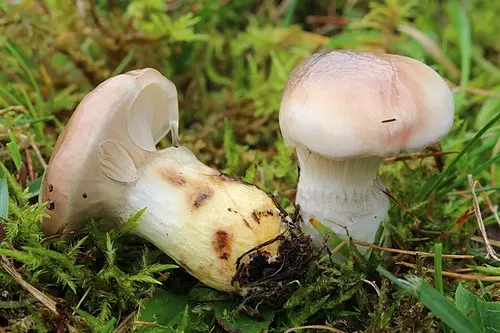 H. Krisp / CC BY 3.0
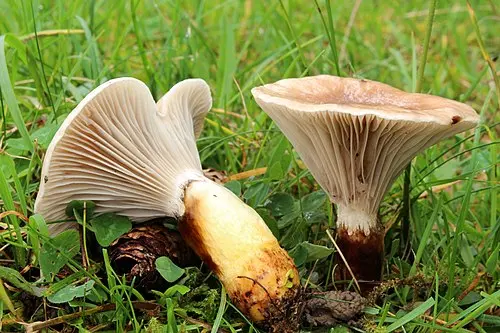 H. Krisp / CC BY 3.0
Species to compare
Similar mushrooms to compare against: