

About this fungus
Cornflower Bolete is a fungus in the Gyroporaceae family. Its habitat and field characteristics are summarised below.
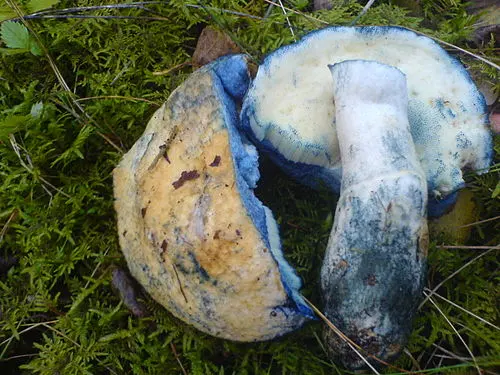
A pale straw, ochre or buff bolete with a dry roughened cap, a brittle stem that develops hollow chambers, and white flesh that rapidly turns a striking cornflower blue when exposed.
What to check
Confirm that the underside has small round pores rather than gills. The pores begin white to pale yellow, the cap is dry and finely velvety or roughened, and the stem is not netted and becomes chambered or hollow. Freshly exposed flesh and bruised pores should turn blue promptly. Use this complete combination because blue staining occurs in many unrelated boletes.
Variation
Caps vary from almost white and straw-yellow to ochre or buff, with a shaggy margin that may split in dry weather. The bruising can appear blue, blue-green or, in some regional collections, violet before deepening. Older stems become more obviously chambered while pore surfaces become more yellow or ochre.
Lookalikes
Several unrelated boletes turn blue. Lurid Bolete, Suillellus luridus, has a darker cap, orange to red pores when mature and a netted stem. Satan's Bolete, Rubroboletus satanas, becomes much stouter and develops orange to red pores. Other Gyroporus species can share the brittle hollowing stem, and molecular work has shown that some Asian and possibly North American blue-staining populations need different regional names. Pale colours, pale pores, a non-netted chambered stem and the full staining pattern should be assessed together.
Habitat and range
A mycorrhizal fungus growing on soil, often sandy, acidic or neutral, beneath both broad-leaved and coniferous trees. European records include birch, oak, pine and spruce, as well as heathland and woodland edges. It is widespread but often uncommon or rare. Similar blue-staining Gyroporus occur in North America and Asia, where the exact name may depend on regional taxonomy.
Food safety
Edible and good.
Use this profile to learn what to examine and compare, not as proof that a mushroom is safe to eat. Check the whole specimen and every important lookalike before reaching an identification.
Photographs
 Snake7 / CC BY-SA 4.0
Species to compare
Similar mushrooms to compare against: