

About this fungus
Crimson Waxcap is a fungus in the Hygrophoraceae family. Its habitat and field characteristics are summarised below.
One of the largest waxcaps, with a broad greasy cap that is deep crimson when fresh and a robust yellow to orange-red stem. Its size and stringy stem help separate it from smaller red waxcaps.
What to check
Look for thick, widely spaced waxy gills that are narrowly attached or nearly free, beginning pale yellow and often becoming orange-red. The dry stem is fibrous and splits lengthwise, usually with a whitish base. There is no ring or volva.
Variation
Fresh caps are dark blood-red to red-orange and fade towards orange or patchy buff with age. Young caps are convex, becoming broadly bell-shaped or nearly flat, and old margins may split.
Lookalikes
Hygrocybe coccinea and other red waxcaps are usually smaller and less robust. Hygrocybe splendissima and Hygrocybe aurantiosplendens can overlap in colour and size. Habitat, stem texture, gill attachment and microscopy may all be needed because cap colour alone is unreliable.
Habitat and range
In Europe it is characteristic of long-established, nutrient-poor grassland. North American records are often from woodland, including redwood, beech or hemlock associations. Waxcap nutrition is more complex than conventional mushroom categories, so the former simple mycorrhizal label is not retained.
Food safety
Edible.
Use this profile to learn what to examine and compare, not as proof that a mushroom is safe to eat. Check the whole specimen and every important lookalike before reaching an identification.
Photographs
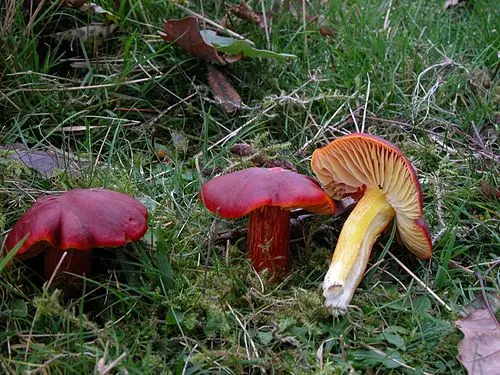 Rosemary Winnall / CC BY-SA 2.5
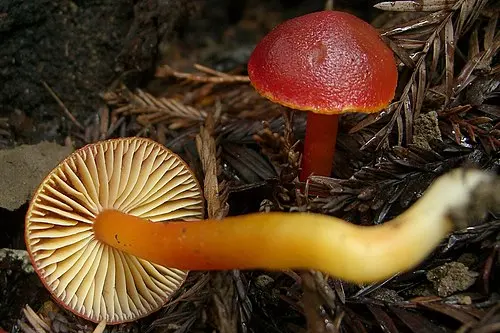 Jason Hollinger / CC BY 2.0
Species to compare
Similar mushrooms to compare against: