

About this fungus
Scarlet Waxcap is a fungus in the Hygrophoraceae family. Its habitat and field characteristics are summarised below.
A small vivid waxcap with a smooth moist scarlet cap, thick reddish-orange waxy gills and a slender red-orange stem that becomes yellow or whitish at the base.
What to check
Look for broad thick waxy gills attached to the stem, a smooth moist but not heavily slimy cap, a paler stem base and a white spore print. There is no ring or volva, and the flesh does not blacken after handling.
Variation
Fresh caps are blood-red to scarlet, fading through orange-red to yellowish orange with age, especially near the margin. Mature caps flatten and can lose much of their original red colour.
Lookalikes
Crimson Waxcap is usually larger with a more fibrous stem. Blackening Waxcaps develop dark or black areas after age or damage and often have more pointed caps. North American material is sometimes best treated as the Hygrocybe coccinea group because regional species limits remain unsettled.
Habitat and range
In Europe it is characteristic of old nutrient-poor grassland, lawns, pasture and clearings, often among moss. In North America and some other regions, similar coccinea-group waxcaps are frequent in woodland. The exact nutritional partnership of waxcaps remains unresolved but is not simple mycorrhiza.
Food safety
Edible.
Use this profile to learn what to examine and compare, not as proof that a mushroom is safe to eat. Check the whole specimen and every important lookalike before reaching an identification.
Photographs
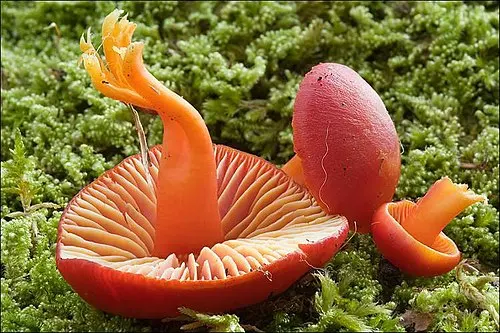 Amadej Trnkoczy / CC BY-SA 3.0
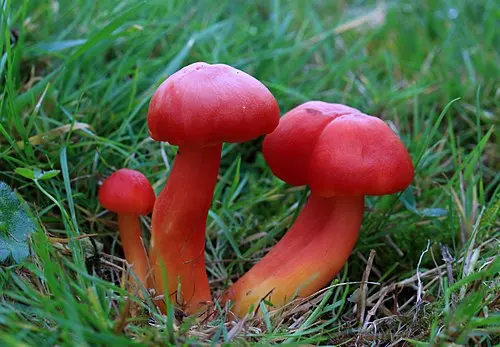 Stu's Images / CC BY-SA 4.0
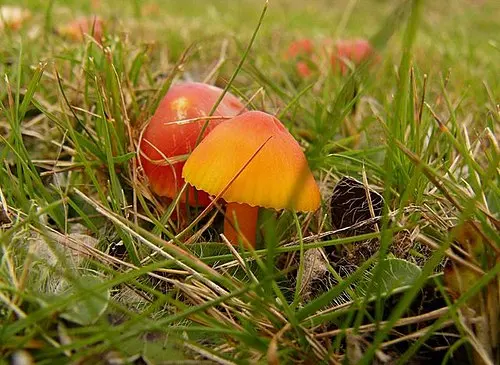 David Baird / CC BY-SA 2.0
Species to compare
Similar mushrooms to compare against: