
About this fungus
Deceiving Knight is a fungus in the Tricholomataceae family. Its habitat and field characteristics are summarised below.
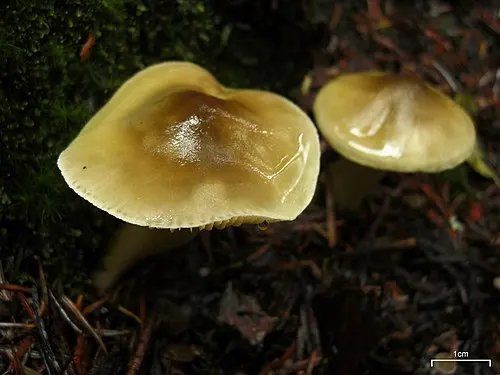
A substantial woodland knight with a greasy yellow-green to olive cap streaked by darker radial fibres. Its gills and stem remain much paler, often developing yellowish marks as they age.
What to check
Look for a 4 to 10 cm cap that begins convex and becomes flatter, often with a broad low bump and an irregular or wavy margin. The yellowish, greenish or olive surface is slightly greasy when moist and crossed by grey-brown to nearly black radial fibres. The pale gills are deeply notched near the stem and age towards dirty yellow-buff. The whitish fibrous stem develops yellow patches but has no ring or volva. The spore print is white. Use the whole combination because colour varies and several related knights are similar.
Variation
Cap colour ranges from fairly bright yellow-green to muted olive-brown, with the centre often darkest. Dry or old caps may lose much of their green tone and look mainly yellow-brown. Crowded fruit bodies can develop distorted caps and wavy margins, while gills and stems become more yellow-buff with age.
Lookalikes
Yellow Knight, Tricholoma equestre, is usually more evenly yellow, including the gills and stem, and lacks the same strong dark radial streaking. Tricholoma portentosum has a greyer cap and a more pleasant farinaceous smell, while Tricholoma viridilutescens and related yellow-green knights may require regional knowledge or microscopy. North American material under the T. sejunctum name may include distinct lineages, so a photograph and cap colour do not always settle the species.
Habitat and range
Ectomycorrhizal on woodland soil with both broadleaved trees and conifers. European sources often emphasise oak and birch, with pine less frequent, while western North American accounts include coniferous and mixed forests. It fruits mainly from late summer through autumn, extending into early winter in some regions.
Food safety
Inedible.
Photographs
 Archenzo / CC BY-SA 3.0
Species to compare
Similar mushrooms to compare against: