

About this fungus
Dusky Puffball is a fungus in the Agaricaceae family. Its habitat and field characteristics are summarised below.
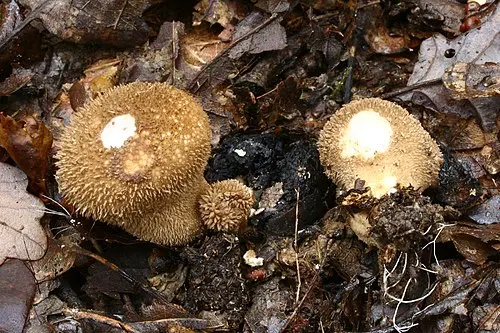
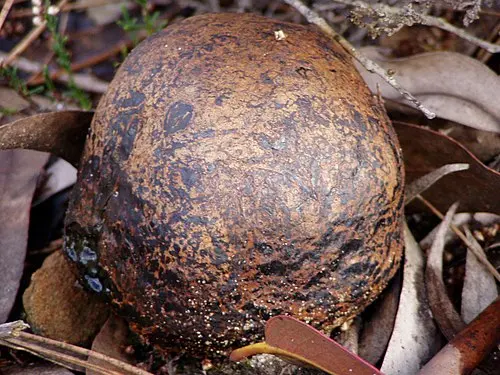
A small brown puffball covered when young with dark pointed spines, becoming smooth and nearly black as it ages.
What to check
Look for dark spines that wear away to leave a net-like pattern, a rounded to pear-shaped body, and an opening at the top in maturity. A section through any young puffball-like fungus must be uniformly white and solid, with no developing cap, gills or stem inside. There is no separate ring or volva.
Variation
The outer surface changes from pale to dark brown and eventually near-black as the spines disappear. Inside, immature white flesh becomes olive-brown and powdery as spores mature.
Lookalikes
Common Puffball is usually paler with detachable pyramidal warts. Earthballs have a much thicker tough skin and a dark interior early. An immature Amanita shows the outline of a cap, gills and stem when sectioned, unlike the uniform interior of a true puffball.
Habitat and range
Saprotrophic on soil and litter, often in conifer woodland, heathland and fixed dunes. It occurs across temperate regions rather than being restricted to one soil type.
Food safety
Inedible.
Photographs
 Strobilomyces / CC BY-SA 3.0
 Júlio Reis (Tintazul) / CC BY-SA 2.5
Species to compare
Similar mushrooms to compare against: