

About this fungus
False Chanterelle is a fungus in the Hygrophoropsidaceae family. Its habitat and field characteristics are summarised below.
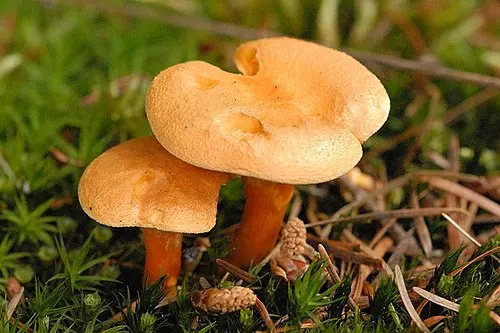
A soft, rather flimsy orange mushroom with a dry, finely felted or velvety cap. Young caps are convex with an inrolled edge, then flatten and develop a central hollow or shallow funnel. It can resemble a true chanterelle at first glance, but its thinner flesh and crowded blade-like gills give it a more delicate build.
What to check
Turn the mushroom over and look closely at the fertile surface. False Chanterelle has thin, crowded true gills that repeatedly fork and run well down the stem. True chanterelles have blunt, thick folds or ridges rather than separate knife-edged gills. Also check the soft flesh, felted cap, lack of a ring or volva and white spore print. No one feature should be used alone.
Variation
The cap is usually yellow-orange, orange or red-orange, sometimes with a somewhat browner centre. Pale forms occur. Colour can fade with age or dry weather, while the gills often remain a stronger orange. Caps range from neatly rounded to wavy and irregular as they expand. Very dark, thickly brown-felted collections may be Hygrophoropsis rufa, a separate species that was formerly treated as a variety of False Chanterelle.
Lookalikes
True chanterelles in the genus Cantharellus are firmer and more substantial, with blunt forked ridges that are part of the flesh rather than thin true gills. Many also have a fruity smell, but smell varies and should not decide an identification. Yellowfoot, Craterellus tubaeformis, has broader, more widely spaced greyish or yellowish folds and a thinner hollow stem. Orange Omphalotus species are poisonous and have true gills, but they usually form larger clusters from wood or buried roots and their gills do not show the same repeated forking. Hygrophoropsis rufa is browner and may require microscopic or molecular confirmation.
Habitat and range
Saprotrophic in forest litter and decaying woody material, especially in conifer woods. It can grow from raw humus, buried wood, rotten logs and stumps, and it also appears on landscaping woodchips and acidic heathland. Fruiting is mainly from late summer through autumn in temperate parts of the Northern Hemisphere. Similar-looking fungi elsewhere should be checked against regional guides because the broader species group is not fully resolved in every region.
Food safety
Edibility is uncertain or disputed.
Photographs
 James Lindsey / CC BY-SA 3.0
Species to compare
Similar mushrooms to compare against: