

About this fungus
Field Blewit is a fungus in the Tricholomataceae family. Its habitat and field characteristics are summarised below.
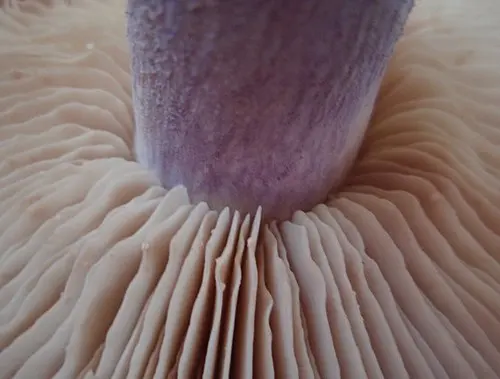
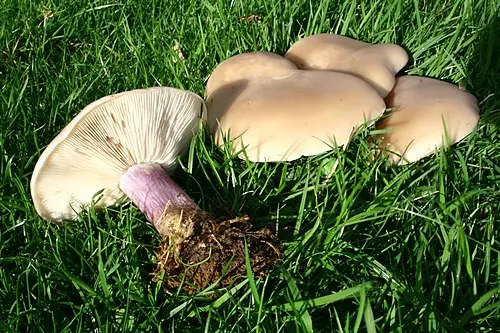
A sturdy autumn grassland mushroom with a smooth beige to grey-brown cap and a fibrous stem washed lilac or violet. It often grows in arcs or rings, and the lilac colour is normally much stronger on the stem than on the cap or gills.
What to check
Look for a solid lilac-flushed stem, crowded whitish to pinkish-buff gills, a pale pinkish-buff spore print, and no ring or volva. The gills are usually notched or nearly free. Open grassland habitat is useful supporting evidence, but colour can fade and a single photograph is not enough for a food identification.
Variation
The cap ranges from cream and pale buff to dirty beige or grey-brown, becoming flatter, depressed or wavy with age. Violet on the stem can be vivid in fresh mushrooms and faint in old, dry or weathered ones. Fruiting may continue into early winter in mild climates.
Lookalikes
Wood Blewit usually carries more violet across the cap and gills and grows mainly in woodland litter. Violet Webcaps grow with trees, develop a cobweb-like veil and produce rusty-brown rather than pinkish spores. Pale Entoloma species have pink spores too, but lack the characteristic violet fibrous stem and have angular spores under a microscope. Check the complete combination rather than treating a purple stem as decisive.
Habitat and range
Saprotrophic in pasture, meadows, parks, lawns and other open grassland, often on neutral or lime-rich soil and frequently in arcs or fairy rings. It is chiefly a European species, so records elsewhere should be interpreted with regional field guides and current local taxonomy.
Food safety
Choice edible.
Use this profile to learn what to examine and compare, not as proof that a mushroom is safe to eat. Check the whole specimen and every important lookalike before reaching an identification.
Photographs
 Horst74 / Public Domain
 Strobilomyces / CC BY-SA 3.0
Species to compare
Similar mushrooms to compare against: